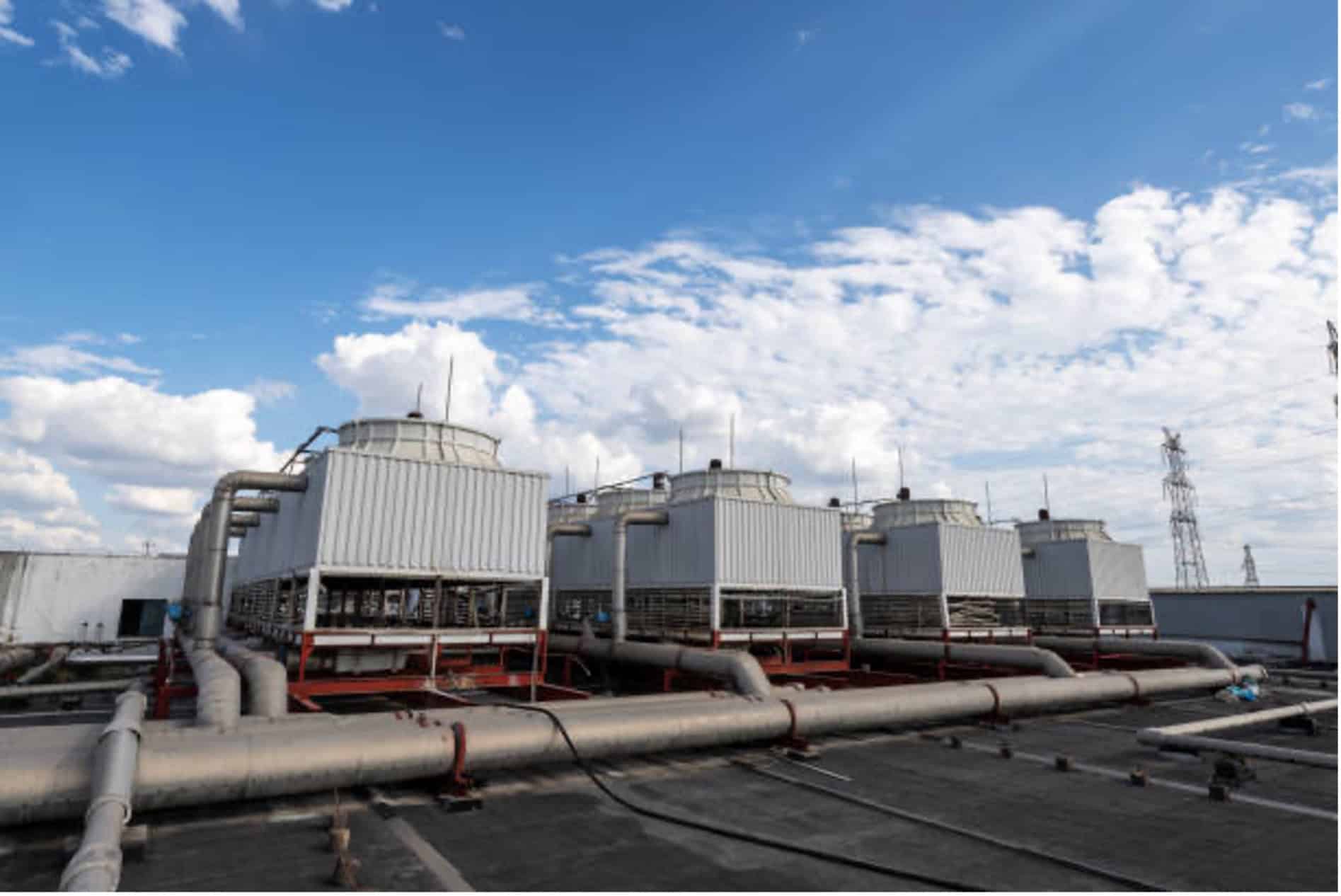
17.06.2025
Prevention of Biological Fouling in Cooling Towers:
In industrial plants, cooling towers are critical for continuity and efficiency of the process. One of the most important problems in these systems is…
 Request a quote
Company
About usDealershipCertificatesReferencesBlogSearch the siteContact
+90 (216) 573 4014[email protected]With the development of industry in the world and in our country, heating and cooling water systems have become an indispensable part of plants. Water treatment is the most effective protection against scale, corrosion and microbiological formation. It also reduces maintenance and operating cost.
Water as the fluid in mechanical installations also brings risks that belong to water. Water can form corrosion or a precipitate. That depends on the mechanical structure and on the physical and chemical conditions.
This formation limits the useful lives of the mechanical sections. It also affects energy, water and labor costs. With chemical water-treatment programs, besides the economic benefit, removal of substances that can harm human health is also provided.
In a building, the average installation expense covers about 10-15% of the total expense. The foreseen use period of the installation is the depreciation period.
If checks are not done on the installation, problems can occur in a short time. Operating expenses can rise, and the foreseen depreciation period will also shorten.
If measures against problems that can form in the installation are taken beforehand, operating costs can fall much more. The foreseen depreciation period will increase.
The investments made to protect the installation form a very small amount beside the cost expenses spent for failures that can occur.
Besides the compatibility of the chemicals used in water-treatment programs with the system, support by a regular follow-up program is also very important. With follow-up programs, systems must be checked by both physical and chemical analysis methods. At the same time, system operating programs must be kept as a chart: meter notes and operating hours. It must not be forgotten that no value that is not measured can be improved.
Include water-treatment firms at the project stage. They can then control the system, and the program quality rises. Water-treatment programs offer measures that save time, money, labor and energy. Heating, cooling, steam and domestic water are the mechanical systems that use water most. Keep corrosion, scale and microbiological formation under control. The useful life stays long. Energy cost does not rise.
A closed loop is a circulating loop. The water inside it serves only for calorie transfer. In a closed loop the water is exposed to no evaporation and no concentration change. For this reason blowdown is not done to adjust the concentration. In theory, make-up water of a negligible size is needed. Water additions usually come from decreases caused by leak problems, by water takes outside control, and by situations such as repair. A closed loop needs water that is of good quality and treated.
The most important subjects met in closed loops are corrosion, microbiological formation and sludging.
Corrosion in closed loops can come from low pH and from dissolved gases (oxygen, carbon dioxide). It can also come from under-deposit, galvanic and erosion corrosion, and from microbiological growth.
Dirt that can form during assembly will also damage the system. When the system is taken into operation, these dirts are carried by circulation to heat exchangers, pumps or coils. They cause deposit formation and flow irregularities. Deposits will both slow heat transfer and increase the corrosion risk. A decrease in the heat-transfer effect will also cause energy costs to rise. To remove or minimize all these factors, the system must be kept under control with suitable chemical cleaning and protection methods from the assembly stage. This is important for a long useful life of the system.
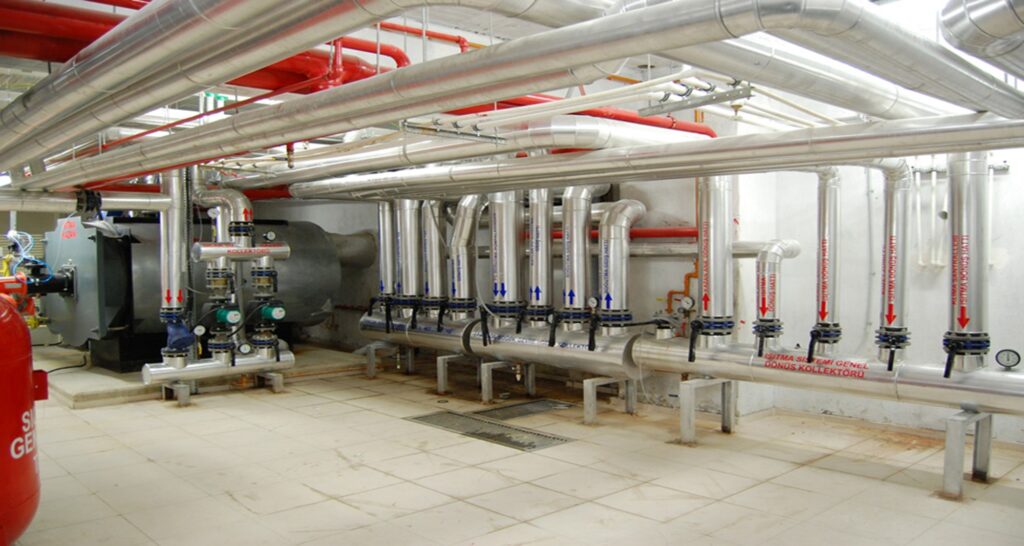
What are the possible problems in central heating and cooling (chiller and condenser) installations?
a) Corrosion: In water-treatment applications of closed-loop systems, the aim is to minimize corrosion. For this aim, corrosion inhibitors that will passivate the metal surface are applied. The target is to minimize the problems that oxygen in the water can cause. Buffer the pH value into the wanted range.
Because the water of a closed loop is not continuously saturated with oxygen, the corrosion problem can be thought small. In practice, because oxygen is frequent and in a light amount, corrosion occurs as deep pits at the hottest points. Galvanic corrosion caused by different metals is also met in closed loops.
To remove oxygen from the system, formation of air in the system must not be allowed. Also, the inhibitor chemicals that are used cut the contact between water and metal. They can get ahead of the damage that oxygen in the water can give to the system.
Our molybdate-based product #CK-42 (#korozyon inhibitor used to prevent #inhibitör); it acts on the metal surface and forms a molecular film. It blocks electron passage between water and metal. It consumes oxygen in the water and protects the metal. Its dispersants prevent a precipitate.
With use of CK-42, full protection against corrosion is provided in central #Isıtma, #Soğutma (#Chiller and #Kondenser) installations.
b) Scale formation: To prevent formation of calcium- and magnesium-based limescale, the make-up water must be softened. The scale problem and the energy losses from it cannot be neglected. The required measures must be taken. The operations to be done for this aim are as follows:
a) Chemical cleaning of scale that has formed: When the plant starts, the required measures may not have been taken. Scale may have formed from an incomplete treatment system. The cleaning operation to be done must be carried out in a uniform way on all heat-transfer surfaces. It is not possible to apply the mechanical cleaning operation in all units. For this reason the operation must be done by a chemical method. In the chemical cleaning, take the scale structure into account. Also take the system properties into account. Care must be taken that the metals in the system are not damaged in the application.
b) The system may be new, or it may have been cleaned chemically. Scale formation must then be prevented. The measures are softening + chemical treatment + filtration.
b) Microbiological formation: One of the problems that can form in closed-loop systems is also microbiological formation. Selection of the chemical to be used depends on the corrosion inhibitor and on the pH level. Oxidizing biocides are not used with nitrite-containing inhibitors. Glutaraldehyde and isothiazolone are the biocides used most commonly.
Protection methods that can be applied in central heating and cooling (chiller and condenser) installations
1. Water softening systems (pretreatment)
The aim is to feed soft water of low hardness at the first fill, or when make-up water is needed. Mains water or well water, with temperature, lets minerals precipitate. That causes a scale layer. The system then has serious energy losses.
For system capacity, the total loop volume matters. The time allowed for the fill also matters. A transfer tank or a reserve tank also affects the capacity. In general, the whole installation is filled in at most 1 day. It is mounted directly on the line.
2. Chemical protection applications (chemical treatment)
In this application the aim is to get ahead of the harmful effects that water can give to the metal (especially corrosion). The chemical shows the wanted effect by cutting the contact of the metal with the water.
Before the applications, a sample must be taken from the water in the installation and the suitability of the water values must be checked. Then dose protection chemical for the total water volume. Take the system into service. After full circulation is provided, a water sample is taken again. It is checked whether the values have come to the wanted range and the chemical amount is checked. After suitability is provided, the system must be tested again with samples at certain intervals for control. If an unsuitability is found in the values, measures must be taken quickly.
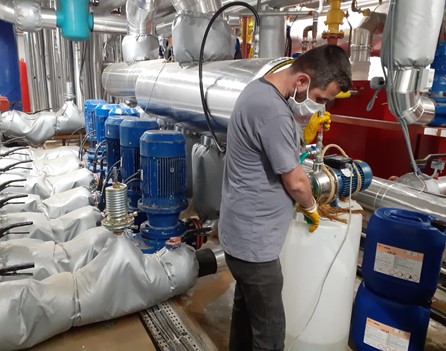
#Chiller installation #CK-42 #Korozyonİnhibitörü (#KorumaKimyasalı) application
As CEMKIMSAN KİMYA, some of the closed-installation treatment products that we developed and produce in our factory:
CK-42 (Corrosion inhibitor in closed-loop heating and cooling systems)
CK-13 (Corrosion inhibitor in closed-loop heating and cooling systems)
C-BIOCIDE 900 (Biocide in closed-loop heating and cooling systems)
3. Filtration applications
The water circulating in the installation must be below a certain turbidity level. Over time, sediment formations and physical dirt are observed inside the installation. These sediments, under the effect of temperature changes, cause crust formations and settling. The sediment that collects in a system that is not filtered is seen below. The target is that these sediments are filtered on the water circulation line and that clean water circulates inside continuously. For this aim, a separate filtration application, apart from the strainers, must be on the system.
Checks that the operators must do:
The pressures of the water in the installation must be checked. Any fall, and a water-decrease condition, must be checked. The decreased amount must be filled from the soft-water line.
After the decreased water is made up, the chemical parameters of the water must be measured periodically (hardness, pH, conductivity, active protection-chemical ratio). According to this, the chemical application must be renewed by the missing amount, to bring the water to the wanted values.
Antifreezes added to the systems change the values of the water over time. Before the application, support must be taken from water-treatment application firms.
Source:
CEMKIMSAN KİMYA lecture notes.
TMMOB Chamber of Chemical Engineers Water Handbook
http://mmoizmir.org/wp-content/uploads/2016/03/mekaniktesisat1.pdf
https://www.cemkimsan.com.tr/post/kapal%C4%B1-devre-%C4%B1s%C4%B1tma-so%C4%9Futma-sistemleri
17.06.2025
In industrial plants, cooling towers are critical for continuity and efficiency of the process. One of the most important problems in these systems is…
15.05.2025
Water has a vital importance in industrial processes. Water is used in steam boilers, cooling systems, drinking-water supply and the production line. That use…
12.02.2025
The main purpose of steam boilers is to heat water, obtain steam, and use this steam as an energy source. These boilers are usually chosen in industrial…
We help you select the correct chemical for your system
Send us your feed water analysis or your requirement. Our technical team will send you a recommendation. +90 (216) 573 4014 · [email protected]