Hardness and silica
Evaporation raises calcium, magnesium and silica in the tower water.
 Request a quote
Company
SolutionsAbout usCertificatesReferencesBlogSearch the siteContact
+90 (216) 573 4014[email protected]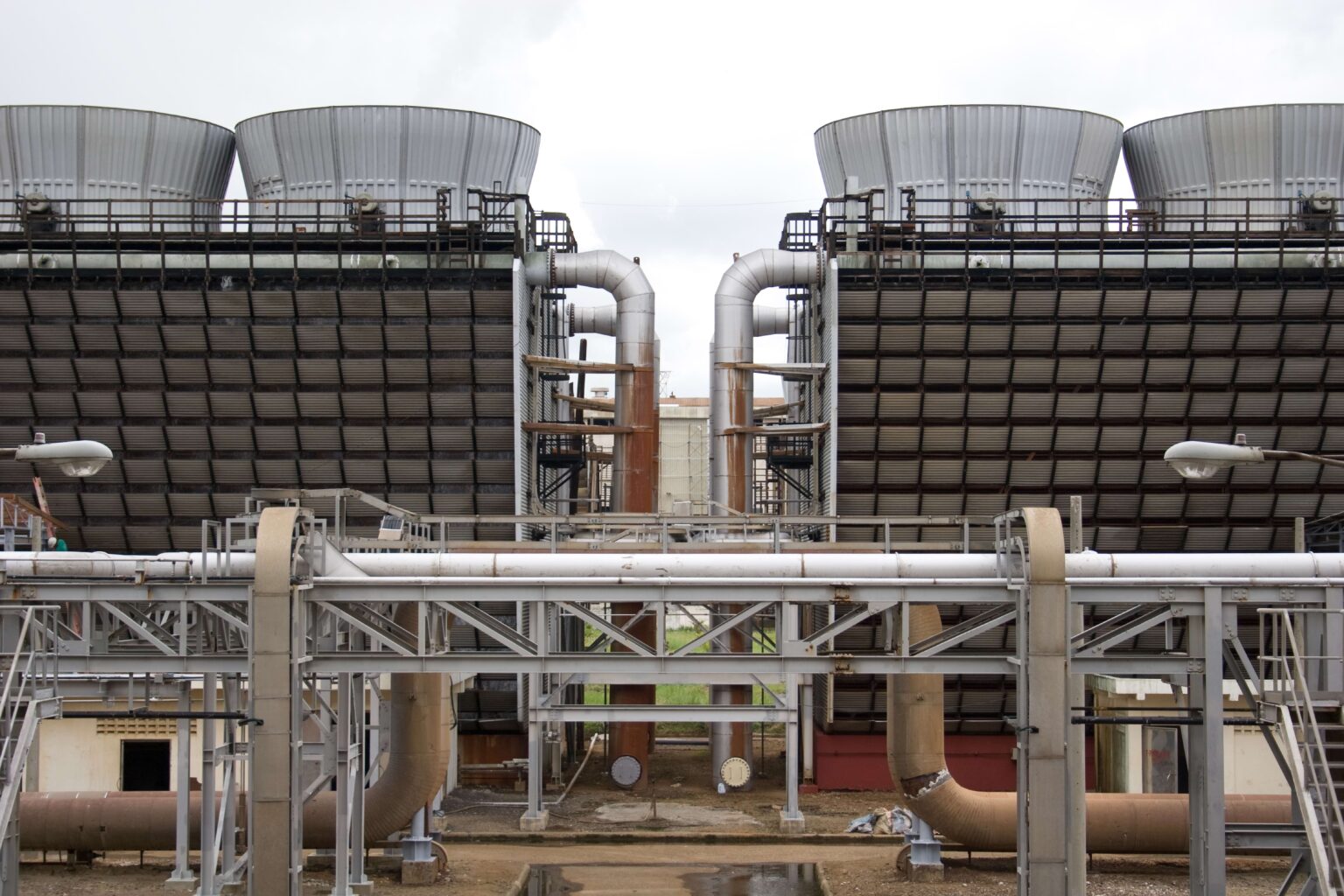
An open cooling tower contacts the air. Evaporation concentrates hardness and silica. Scale and corrosion block heat transfer. Algae, biofilm and bacteria block the fill.
Evaporation raises calcium, magnesium and silica in the tower water.
Heat in the exchanger turns minerals into a hard layer on the metal.
High alkalinity raises the scale risk. Low pH raises the corrosion risk.
Dust, light and heat that enter the tower grow algae and bacteria.
A cooling-water chemical keeps hardness off the metal and limits corrosion.
The correct pH range sets the balance between scale and corrosion.
Suspended particles and sludge leave with blowdown. They do not stick to the surface.
An open system uses a biocide for algae and biofilm, and a separate cleaner for film that is already there.
This page does not give a dosage. Select the product from the tower water analysis.
Stabilized Phosphate Cooling Water Treatment Chemical
It decreases the risk of scaling and corrosion in cooling towers.
Stabilized Phosphate Cooling Water Treatment Chemical – For Copper (NSF APPROVED)
Its phosphate base gives effective scale and corrosion prevention.
All-Organic Cooling Water Treatment Chemical
It decreases the risk of scale and corrosion in cooling towers.
Zinc Chloride Cooling Water Treatment Chemical – For Copper
It protects copper equipment against corrosion.
Cooling Water Dispersant
Ck 180 is a dispersant for cooling towers. It prevents deposits of suspended particles and sludge.
Alkalinity – pH Adjuster for Cooling Towers
It adjusts the alkalinity and the pH balance in cooling towers. The correct pH range decreases the risk of scaling and corrosion.
Biocide for Open Cooling Systems
It prevents microbiological contamination and biofilm. It has an important function to decrease the Legionella risk.
Bromine-Based Biocide for Open Cooling Systems
It is a bromine-based biocide for open cooling systems. It protects against microbiological contamination.
Biofilm Cleaner
It removes the biofilm that collects in cooling systems over time.
Biocide for Open and Semi-Open Cooling Systems
It prevents algae, bacteria and fungi. Thus, it prevents the fouling and corrosion that this biological growth causes.
The frequency depends on the water values and the risk of the system. Make-up water quality, cycles of concentration, load, season, and past scale, corrosion or biological problems set that risk. The operator checks conductivity, pH, hardness, alkalinity and the inhibitor level often. In most towers this check is daily or weekly. A more detailed analysis is less frequent. Check more often after a change, after a problem, and in the hot season. Cemkimsan can help you set the correct plan.
Use Ck 220 or the heavy-metal-free Ck 420 for scale and corrosion. Select Ck 229 or Ck 439 for copper parts. Use Ck 180 for suspended sludge and Ck 699 for pH. The exact product depends on the tower water analysis.
Add a biocide to the program when you see algae, bacteria or biofilm. C biocide 886 prevents biofilm in open cooling and lowers the Legionella risk. C biocide 1050 prevents algae, bacteria and fungi. C biocide 1100 removes biofilm that has already formed.
No. The scale and corrosion chemical, pH, the dispersant and the biocide are separate jobs. The tower water analysis shows which one you need.
Send your tower water analysis or your latest operating results. Our technical team will look at scale, corrosion and biological control together.
We reply to quote requests within 12 hours.