17.06.2025
Prevention of Biological Fouling in Cooling Towers:
In industrial plants, cooling towers are critical for continuity and efficiency of the process. One of the most important problems in these systems is…
 Request a quote
Company
About usDealershipCertificatesReferencesBlogSearch the siteContact
+90 (216) 573 4014[email protected]Scale forms by crystallization and accumulation of salts as the water temperature and the salt concentrations in the water increase.
Calcium carbonate and magnesium carbonate crystallize and solidify as they heat in water. Crystallization starts at about 30-35 oC. As the heat increases, crystallization speeds up.
Hot water, boiling water, steam boilers, cooling units and heat exchangers share two problems. Those problems are scale and corrosion.
Scale forms in steam boilers and in cooling-water systems when the feed water is not treated enough. It also forms when the mineral concentration of the system water passes saturation.
When a chemical additive that prevents scale formation is not used, the mineral-bearing water layer on the hot boiler tubes deposits the minerals on itself. This follows the leaving of water vapor, carbon dioxide, oxygen and similar gases. It cooks them and hardens them. This hardened layer is called scale or limescale.
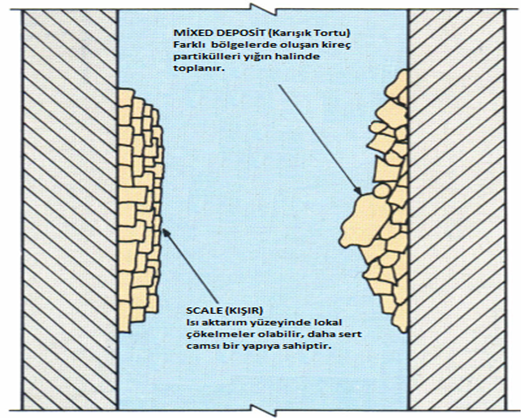
After a deposit has formed once, the particles start to stick to one another. Scale formation then continues at a higher speed.
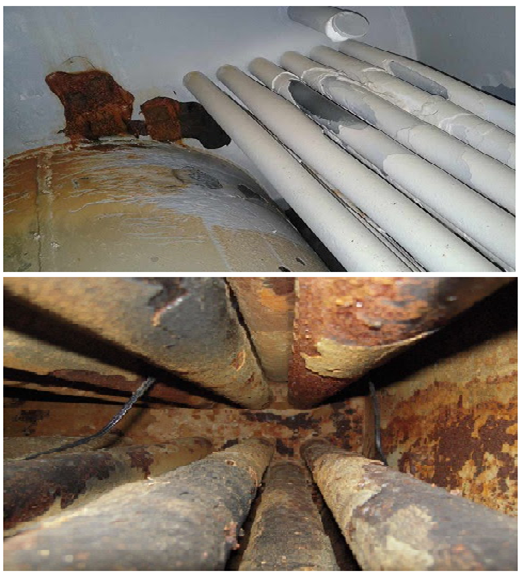
As a result of scaling and corrosion, a limescale layer of a certain thickness forms. This limescale forms a strong insulation layer and blocks heat transfer.
This insulation layer causes excess fuel use and a fall in efficiency. It raises the temperature on the heat-transfer surfaces. As a result of the high temperature on the heat-transfer surfaces, thermal stresses, burning and material deformation occur in the metals.
WHAT IS THE EFFECT OF SCALE ON FUEL USE?
A scale thickness of 2 mm causes a fuel loss of 8-10%, depending on its structure.
Minerals in the water settle on heat-transfer surfaces and form scale. When the scale thickness reaches certain sizes, fuel use first increases. Then metal deformation follows. Later it reaches dangerous sizes such as perforation and bursting.
In the examinations that were made:
A scale thickness of 1 mm, depending on its structure, 5-8%,
A scale thickness of 2 mm, depending on its structure, 8-10%
A scale thickness of 3 mm, depending on its structure, 10-15%
A scale thickness of 4 mm, depending on its structure, causes a fuel loss of 15-25%.
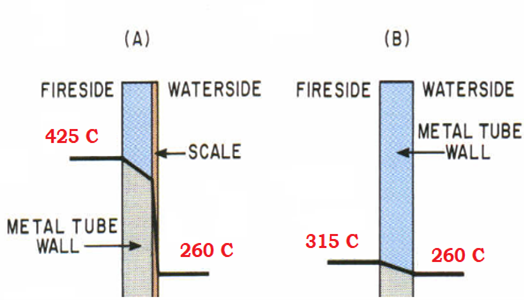
In systems that exceed 2 mm, cleaning must be done.
In steam boilers, after a scale thickness of 2 mm, thermal stresses slowly strain the construction. Loosening occurs between tube sheets and tubes. The heat conductivity and the stress of the scale layer that covers the metal are different from the metal. For this reason, leaks will start at the tube-sheet to tube connections in the boiler.
As the scale thickness increases, the number of leaking tubes will also increase, as a natural result.
When the scale thickness reaches 4 mm, the crystal structure of the metal will be damaged and hardening will occur. The boiler system will then leave the state of being reliable. Hazards such as furnace collapse, tube burst and tube-sheet cracks will be expected at any moment. Also, narrowing of the tube wall because of scale, a decrease in volume, a fall in efficiency, and strain on the discharge pumps will appear. Chemical water treatment in steam boilers, heat exchangers and boilers prevents scale formation. That is the way out of these problems. In systems where scale has formed, chemical cleaning must be done.
WHAT MUST BE DONE TO PREVENT SCALE FORMATION?
Raw water must be purified and chemical treatment must be done.
The main reason for deposit formation is the impurities that the water contains. (Especially hardness and suspended matter.) With developments in feed-water preparation systems, feed-water impurities are removed to a large extent. A good internal-treatment program is still required. A better pretreatment system produces water of higher purity. Internal-treatment cost is then lower, and its success is higher.
Today, almost every boiler feed-water preparation system has systems such as a softener or dealkalizer, demineralizer and reverse osmosis. In the waters obtained with these systems, hardness leakage is lowered to a value of 0.01 -2 ppm.
The softening system works basically by the ion-exchange method. Ca and Mg ions in the water are held by the resin inside the softening tank and are later discarded, and the water is softened. For a detailed examination of the softening system:
/su-yumusatma-sistemleri/ you can reach it with this.
However, at the high temperature of boiler conditions, solubility is gone completely. Even at these hardness values, deposit formation does not disappear. At this point, a chemical method uses special chemicals so that the minerals that form hardness in the water stay suspended in their scale structures.
As CEMKIMSAN KİMYA, some of the steam-boiler treatment products that we developed and produce in our factory;
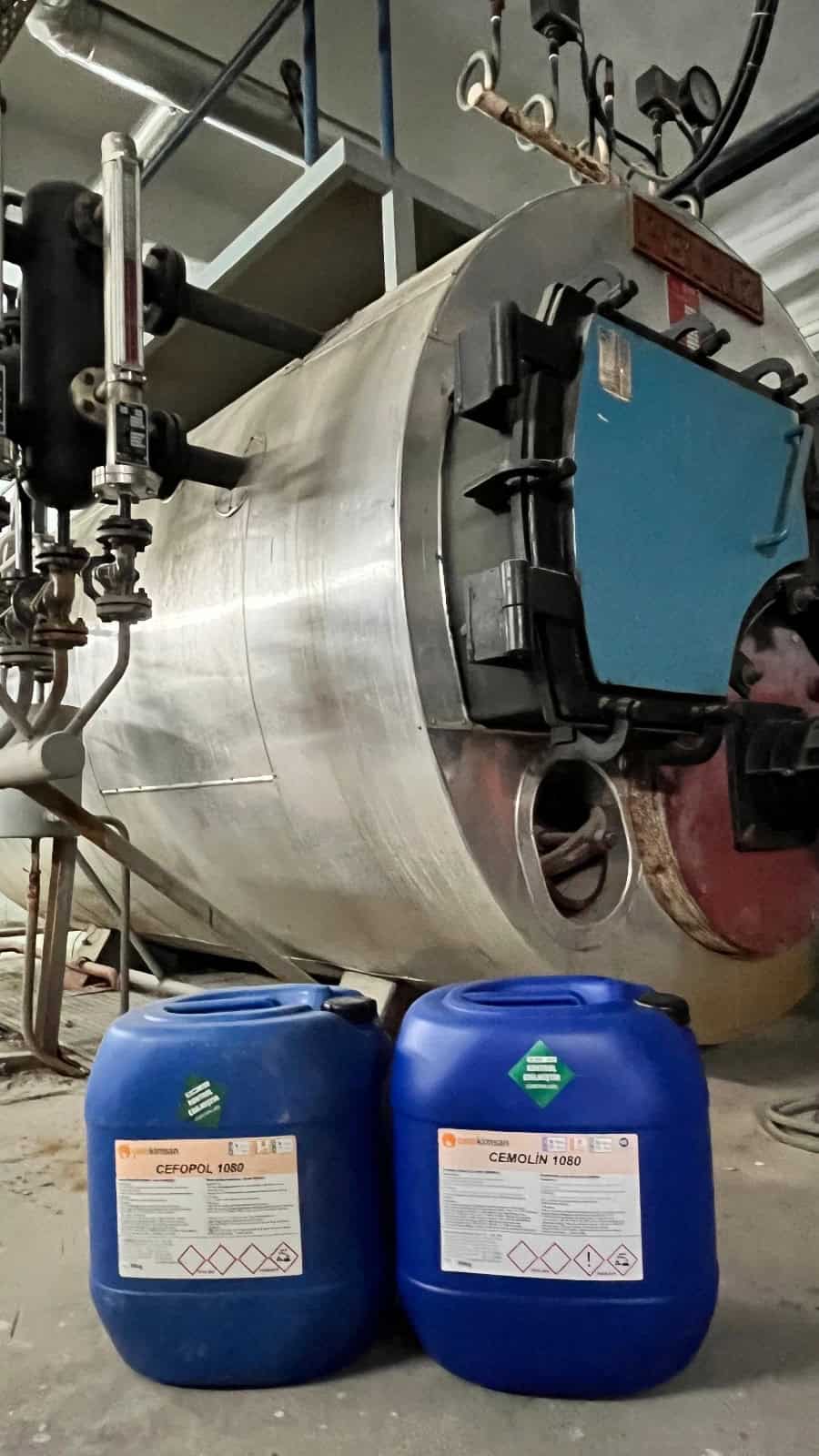
Cefopol 1080 (Multifunction boiler-water treatment chemical)
Cefopol 1040 (NSF-approved steam-boiler scale and corrosion inhibitor suitable for use in food production)
Cemolin 1080 (NSF-approved steam-line corrosion inhibitor suitable for use in food production)
Cefopol 6035 (Hardness stabilizer and scale preventer for steam boilers that operate at high hardness)
Cefolin 1080 (Multifunction boiler and steam-line treatment chemical)
SOURCE:
CEMKIMSAN KİMYA lecture notes
TMMOB Chamber of Chemical Engineers Water Handbook
http://web.hitit.edu.tr/dersnotlari/ibrahimbilici_10.10.2017_8C5O.pdf
17.06.2025
In industrial plants, cooling towers are critical for continuity and efficiency of the process. One of the most important problems in these systems is…
15.05.2025
Water has a vital importance in industrial processes. Water is used in steam boilers, cooling systems, drinking-water supply and the production line. That use…
12.02.2025
The main purpose of steam boilers is to heat water, obtain steam, and use this steam as an energy source. These boilers are usually chosen in industrial…
We help you select the correct chemical for your system
Send us your feed water analysis or your requirement. Our technical team will send you a recommendation. +90 (216) 573 4014 · [email protected]