Prevention of Biological Fouling in Cooling Towers:
In industrial plants, cooling towers are critical for continuity and efficiency of the process. One of the most important problems in these systems is biological fouling. It lowers system performance and it threatens equipment life.
What Is Biological Fouling?
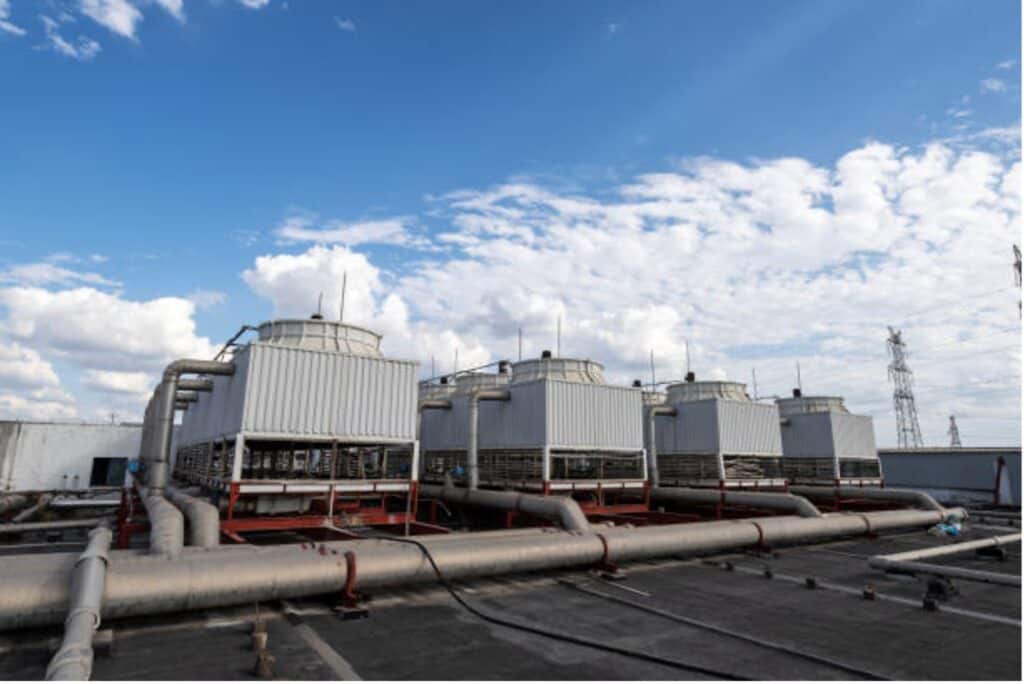
Cooling towers are open systems that touch the ambient air. They therefore make a favorable environment for microorganisms such as algae, bacteria, fungi, and moss. In this environment, with moisture, heat, and light, microorganisms multiply quickly. They form biofilm layers inside the system.
These biological layers:
reduce heat transfer,
block water flow,
accelerate corrosion,
increase energy cost,
and prepare an environment for harmful bacteria such as Legionella.
Why Must You Prevent It?
If you do not prevent biological fouling, it can cause:
energy losses,
unplanned stops,
equipment damage,
and risks to public health.
Legionella bacteria can multiply in these systems. If you do not do preventive chemical treatment, serious health problems can occur, and legal liability can arise.
Prevention of Biological Fouling in Cooling Towers: 2
How Do You Prevent It?
These steps are critical to prevent biological fouling in cooling towers:
1. Regular chemical treatment
At Cemkimsan, we stop microorganism growth with biocide and dispersant products that we develop for the system. We also dissolve biofilm that has already formed. Correct chemical selection and dosage are the basis of system health.
2. Online monitoring and measurement systems
When you see biological fouling with the eye, it has usually already advanced. For this reason, continuous monitoring of water parameters is necessary for early action. Examples are pH, conductivity, free chlorine, and ORP.
3. Physical cleaning and periodic maintenance
Clean the ventilation panels, the water spray nozzles, and the basin zones of cooling towers at regular intervals. Remove collected sediment and biological deposits physically.
4. Suitable design and operating conditions
Factors such as water recirculation time, tower type, ambient temperature, and air quality affect biological fouling. For this reason, review the system design and the operating parameters.
What Do We Offer as Cemkimsan Kimya?
Biological fouling in cooling towers is not only a maintenance matter. It is a critical subject for efficiency, safety, and sustainability. It affects the future of the plant.
As Cemkimsan Kimya:
we develop biocide and dispersant solutions for industrial systems,
we use continuous monitoring and control systems, and we take a preventive approach,
and we give optimum performance with a water treatment program for each plant.
We minimize biological risks, and we maximize your system efficiency.
CK 229: Phosphonate-based treatment chemical for scale and corrosion control in open and semi-open cooling towers. It breaks the crystal structure of minerals that cause scaling and makes them amorphous, so blowdown can remove them. It prevents corrosion on copper surfaces.
CK 429: All-organic treatment chemical for scale and corrosion control in open and semi-open cooling towers. It is effective at high pH values without the need to use acid. Its all-organic structure is friendly to the environment. It prevents corrosion on copper surfaces.
C BIOCIDE 886:Biocide designed for microorganism control in industrial process water in open cooling towers. It prevents the formation of moss, bacteria, and fungi. It prevents the blockage, contamination, and corrosion that this biological growth causes. You can use it safely on metal surfaces that contain copper.
CK 699: Auxiliary product used to adjust pH and alkalinity in cooling systems. It prevents the deposit problem that a high pH value causes.
CK 180: All-organic dispersant for scale control in open cooling towers. It stops suspended solids in the water from joining, settling, and sticking to the metal surface, and it prevents deposit formation in cooling towers. It gives clean surfaces so that corrosion inhibitors can reach the metal surfaces easily. When you apply it at high dosages, it also cleans old deposits slowly.
Hakan ÇOBAN
Chemical engineer
Water treatment consultant
Chamber of Chemical Engineers of TMMOB, Water Handbook
Water has a vital importance in industrial processes. Water is used in steam boilers, cooling systems, drinking-water supply and the production line. That use…
The main purpose of steam boilers is to heat water, obtain steam, and use this steam as an energy source. These boilers are usually chosen in industrial…
How Do Antiscalants Prevent Scaling? Antiscalants prevent scaling by two main mechanisms: threshold inhibition and dispersion. The correct combination of these…
Cookie preferencesWe use cookies to improve the website and to measure our ads. Strictly necessary cookies are always on. For the other cookies, we ask for your consent. Cookie Policy