17.06.2025
Prevention of Biological Fouling in Cooling Towers:
In industrial plants, cooling towers are critical for continuity and efficiency of the process. One of the most important problems in these systems is…
 Request a quote
Company
About usDealershipCertificatesReferencesBlogSearch the siteContact
+90 (216) 573 4014[email protected]A steam boiler is a closed vessel. It produces steam at the wanted temperature, pressure and quantity from water or another liquid. The heat comes from burning any fuel (solid, liquid or gas) or from electrical energy. Steam-boiler tubes and equipment consist only of iron alloys. The parts are the economizer, the evaporator and the superheater.
As a result of the interaction of water and metal, the basic problems that occur are corrosion, deposits and foaming.
The corrosion problem must be watched very carefully.
In the face of scaling, deposit and foaming problems, chemical and mechanical work can return the steam boiler to its old performance.
Corrosion is the event in which metals lose their metallic properties as a result of chemical, physical and electrochemical reactions with their environment (with water). It is difficult to see the effect of corrosion in short periods of time. As the time scale increases, the damage from corrosion can be seen much more clearly.
The metal that forms the steam boiler can be exposed to corrosion. Replacement of tubes, the furnace and the tube sheet can then come onto the agenda.
Types of corrosion in steam boilers:
Oxygen corrosion
Carbonic acid corrosion
Caustic cracking
Acid corrosion
Hydrogen cracking
Under-deposit corrosion
Oxygen corrosion: Oxygen is a very important corrosion factor. It causes corrosion in the form of deep pits and pitting on the metal. A rise in temperature speeds up the corrosion reaction. As the solubility of oxygen falls as a function of temperature, oxygen is present in the water in a supersaturated state. It tends to leave the liquid phase and go toward the boiler walls. Because it carries excess oxygen in the air-free places it touches, it gives an anodic reaction. Carbonic acid corrosion:
CO2 corrosion: Dissolved CO2 increases the acidity a little, according to the following equation. CO2 + H2O ↔ HCO3- + H+ The acidity that comes from this event is important especially in condensate circuits. CO2 sent to the boiler comes from the decomposition of bicarbonates and dissolves in the condensate. Caustic cracking:
Caustic cracking is also the name for caustic or alkaline (alkali) corrosion. This form of corrosion is an event that occurs between the crystal structure of the material. Alkaline accumulation can occur in a break or a crack on the wall. This event is now rarely met in modern boilers. Because almost all of them are welded, alkalis cannot concentrate in one place. Low pH corrosion (acid corrosion):
At low pH levels, one of the important corrosion types caused by hydrogen is also hydrogen cracking. The corrosion type it causes is different from uniform acid corrosion.
Hydrogen cracking is usually seen in boiler evaporator tubes and sometimes in superheater tubes. In tube bursts that it causes, a thinning of the tube wall thickness is not seen. Hydrogen cracking is usually seen under dense deposits. Hydrogen that forms in a mildly alkaline environment cannot reach the metal. Hydrogen that forms under a deposit at low pH and at high temperatures spreads easily into the metal.
Hydrogen cracking:
In boilers that operate at low pH conditions, corrosion caused by hydrogen, as distinct from acid corrosion, is called hydrogen cracking. Hydrogen released as a result of corrosion under a deposit in the boiler spreads inside the metal at high temperature. It reacts with the carbon in the structure of the steel and carries out the event called “decarburization”. Hydrogen that forms under a deposit at low pH and at high temperatures spreads easily inside the metal. CH4, that is methane, forms when hydrogen joins with carbon. Under temperature and pressure it forms cracks between the metal grains. It also forms separations. It causes the metal to be destroyed. Under-deposit corrosion:
The lower parts of deposits that form in steam boilers cause local corrosion by the various potential differences they create. To prevent under-deposit corrosion, take care with chemical water treatment and keep the solid-matter concentrations of the boiler water under control. Prevention of corrosion in steam boilers Steam-boiler (economizer, evaporator and superheater) tubes and equipment are only iron alloys. Prevention of corrosion is therefore very important. There are two main factors that cause corrosion in steam boilers. One is low pH. The other is dissolved gases (especially oxygen and carbon dioxide). The measures to reduce corrosion in boilers are as follows. 1. Raise the pH of the boiler water and the feed water, and make them alkaline. 2. Remove dissolved gases (O2 and CO2 and similar). 3. Coat the metal surface with a protective magnetic layer and passivate it. 4. Limit and monitor the concentration of free hydroxide, silica and chloride ions. 5. Corrosion products that will come from the condensate and the feed water must be removed by preventing corrosion. 6. Prevent the deposit that shows an effect of speeding up corrosion, and clean the deposit that has formed.

Steam-boiler protection products that Cemkimsan Kimya developed and that we produce in our factory;
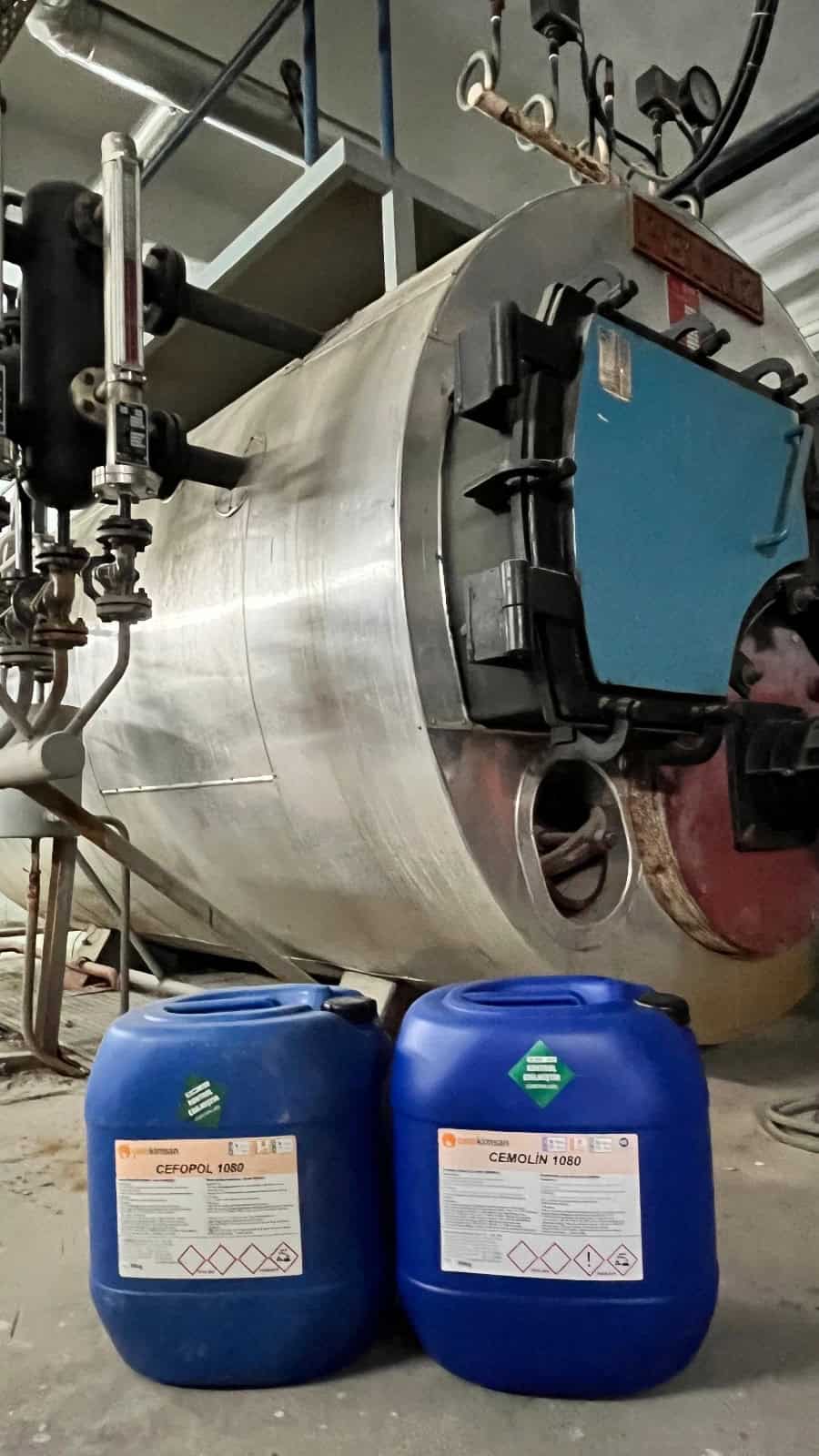
Cefopol 1080; Multifunction boiler-water treatment chemical.
Cemolin 1080; NSF-approved steam-boiler treatment chemical suitable for use in food production.
Cefopol 4080; Corrosion-inhibitor treatment chemical used in steam boilers.
Cefopol 6018; Boiler-water treatment chemical with dispersant properties.
Source;
Cemkimsan Kimya lecture notes,
TMMOB Chamber of Chemical Engineers Water Handbook
http://dspace.yildiz.edu.tr/xmlui/bitstream/handle/1/10398/0042247.pdf?sequence=1&isAllowed=y
http://www1.mmo.org.tr/resimler/dosya_ekler/7737ef924014622_ek.pdf
17.06.2025
In industrial plants, cooling towers are critical for continuity and efficiency of the process. One of the most important problems in these systems is…
15.05.2025
Water has a vital importance in industrial processes. Water is used in steam boilers, cooling systems, drinking-water supply and the production line. That use…
12.02.2025
The main purpose of steam boilers is to heat water, obtain steam, and use this steam as an energy source. These boilers are usually chosen in industrial…
We help you select the correct chemical for your system
Send us your feed water analysis or your requirement. Our technical team will send you a recommendation. +90 (216) 573 4014 · [email protected]