
While membrane technology can be used on its own depending on the characteristics of the raw water, it is generally used in combination with several other systems. Generally speaking, it can be applied as shown below. Its main components are:
Raw Water Tank: A tank where raw water brought from the source is stored until it is ready for treatment.
Chemical Dosing Systems: These are pumping units capable of dosing disinfection chemicals into a RO unit; they operate at low noise levels and can be flow-controlled, probe-controlled, and operated either automatically or manually.
In membrane systems, the water passing through the membrane emerges with a high degree of purity, while a high concentration of impurities remains on the membrane. When these impurities reach a certain concentration, they form crystals that build up, impairing the membrane’s ability to allow water to pass through and eventually causing the system to clog.
For this reason, the use of antiscalants is necessary in membrane systems.
When added to the feedwater of a membrane process, antiscalant delays the precipitation/crystallization points of salts present in the water (CaCO₃, CaSO₄, SiO₂, BaSO₄, MgSO₄, CaF₂, etc.) and reduces fouling through its high capacity to dissolve scale and contaminants. This extends the service life of the membranes.
When the selected antiscalant is applied correctly, it significantly delays crystallization, thereby causing blockages to occur much later. The need for sulfuric acid and hydrochloric acid is reduced, and the risks associated with the use of these chemicals are minimized. Operating, cleaning, and maintenance costs are reduced. It provides a higher recovery rate in reverse osmosis systems, allows the system to operate for longer periods, reduces the concentrate flow rate, and extends membrane life.
Membranes that are clogged or have developed bacterial growth can also be cleaned with membrane cleaning chemicals and restored to a usable condition.
At Cemkimsan Kimya, we have developed and manufacture at our plant our antiscalant products;
C-SCALANT 6080: A protective product for membranes fed with water containing high levels of silica. It prevents membrane fouling and extends their useful service life.
C-SCALANT 2005: A membrane protection product. It prevents membrane clogging or capacity loss and extends their useful service life.
C-SCALANT 1085: A membrane protection product. It prevents membrane clogging or capacity loss and extends the useful service life of the membranes. Suitable for use in drinking water production facilities. NSF-certified.
Cleaning clogged and bacteria-infested membranes;
C-MEC 102: Acidic membrane cleaner; used to clean membranes whose pure water production capacity has decreased due to scale and similar contaminants. It is an acidic product with a low pH value.
C-MEC 100: An organic acidic membrane cleaner used to clean membranes whose pure water production capacity has decreased due to scale and similar contaminants. It is an acidic product with a low pH value.
C-MEC 200: Alkaline membrane cleaner; used to clean membranes whose pure water production capacity has decreased due to colloidal and similar contaminants. It is an alkaline product with a high pH value.
C-MEC 17: Membrane Disinfectant is a membrane cleaning chemical used to remove biological deposits that accumulate on R.O. membranes over time.
Sand Filters: These are filtration systems that remove contaminants such as turbidity, mechanical impurities, and sediment from water by trapping suspended solids; they typically operate on a time-controlled basis. These filters contain quartz sand in various particle sizes and quantities. The first layer consists of particles ranging from 3.2 to 5.6 mm, followed by a second layer with particles ranging from 1 to 2 mm, and finally a third and final layer with particles ranging from 0.4 to 0.8 mm. Due to the filter’s tendency to clog quickly, frequent backwashing (every 80–100 hours) is required. Because the sand material is coarse, filters that provide finer filtration must be used downstream of the coarse filter.
Soft Water Tank: This is the tank where raw water is stored after treatment for use as soft water. The soft water is then fed from here to the second reverse osmosis unit.
Pure Water Storage Tank: This is the final stage where raw water is stored after treatment, ready to be used as pure water. From here, the pure water is distributed to its points of use via pumps.
Auxiliary Equipment: Water supply pumps, automatic and manual control valves, low- and high-pressure piping, PLC-controlled control panel, and other instruments.
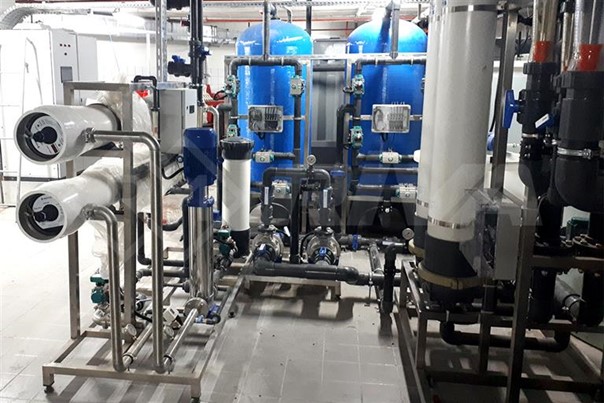
Reverse Osmosis Systems: Reverse osmosis technology is the most precise filtration technology known.
This technology, developed in recent years, is used in the purified water production facilities of large companies. The Reverse Osmosis (RO) system is a process for removing cations and anions from water; this system, which achieves a purification rate of 90–99.8%, is designed based on the characteristics of the raw water (conductivity, TDS). Most RO systems are designed for feed water at 25°C. Microbiological activity in water increases rapidly at temperatures below 15–18°C. Therefore, the most efficient operating temperature range for an RO system is 15–18°C. In cold climates where temperatures fall below this range, a heat exchanger is installed in the system to raise the temperature. Well water RO systems are designed for 60–75% recovery, while seawater systems are designed for a maximum recovery of 30–40%. In industrial applications, RO systems typically operate at 60 psi and 25°C with a standard daily water production (GPD) of 45 gallons. A high permeate flow rate can be achieved in an RO system, but this carries risks such as a shorter membrane service life and increased chemical cleaning costs. Operating Principle: The reverse osmosis system operates on the principle of cross-flow filtration (the reverse of the osmotic balance found in nature). In this system, raw water subjected to high pressure is forced toward the membranes; here, a portion of the raw water passes through the semi-permeable membrane—which has pores measuring 1–10 Å (Å = Angstrom, 10⁻¹⁰ meters)—to the other side under high pressure, forming pure water, while the heavy concentrate remaining on the feed side is flushed off the membrane surface and discharged to the drain.
hhttps://www.cemkimsan.com.tr/post/antiskalant-ve-membran-temizleyiciler
https://www.ttmd.org.tr/yayinlar/ttmd-dergisi#gallery-237
http://www.suvecevre.com/edergi/19/149/index.html
TMMOB Chamber of Chemical Engineers; Water Handbook
Cemkimsan Chemistry Lecture Notes