17.06.2025
Prevention of Biological Fouling in Cooling Towers:
In industrial plants, cooling towers are critical for continuity and efficiency of the process. One of the most important problems in these systems is…
 Request a quote
Company
About usDealershipCertificatesReferencesBlogSearch the siteContact
+90 (216) 573 4014[email protected]Corrosion
Corrosion is a deterioration process that the material forms by reacting with its environment. Because of the serious results of corrosion, it has become a problem on the world scale.
Corrosion, which we also meet in daily life, causes plant shutdowns and even closures. It causes spending of valuable resources, spoilage or loss of products, a fall in efficiency, high-cost repairs, and designs that are more expensive than needed. Corrosion is a complex problem. It enters the interest of more than one scientific field. There is confusion about where responsibilities start and where they end.
Corrosion control can be effective if the process is recognized and the mechanisms are understood. It can be effective if materials with high corrosion resistance are used, a suitable design is made, and protective systems are used. Large organizations, the related industry branches and government organizations have set up groups and committees to take up corrosion-related problems.
Corrosion cell
Corrosion is an electrochemical process that requires flow of electrons and ions.
Metal loss (corrosion) occurs at the anode.
There is no metal loss at the cathode. (The cathode is protected.)
Electrochemical corrosion requires electron transfer at the interface of the metal and the electrolyte.
Corrosion occurs in a corrosion cell that consists of 4 parts.
– Anode
– Cathode
– Electrolyte
– Metallic bond
Electrons that form by production of metallic ions at the anode pass over the electrical path. They pass to the cathodic surface that is immersed in the electrolyte.
They react with the positively charged ions in the electrolyte and set up electrical balance again.
Let us examine the corrosion process as in the figure. The cell has an anode and a cathode on the same metallic surface in water:
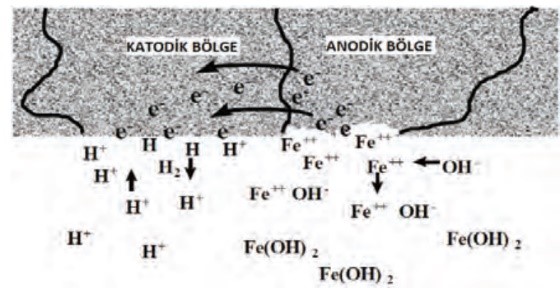
The same metal contains the anode, the cathode and the electrical path (metallic bond).
Water provides the last component of the corrosion cell, that is the electrolyte.
The electrolyte (aqueous solution) has ionized so that it contains small amounts of hydrogen (H+) and hydroxyl (OH–) ions.
Metal ions leave the anodic surface to enter the electrolyte. They leave behind electrons that will flow over the electrical path to the cathodic surface.
On the cathodic surface, electrons that come from the anode meet the hydrogen ions in the electrolyte. One hydrogen ion accepts one electron and turns into a hydrogen atom. The hydrogen atom can join with another hydrogen atom to form a hydrogen-gas molecule. That molecule will either stick to the cathodic surface or later be released as a bubble.
In some cases the hydrogen atom can enter the metal lattice and create hydrogen embrittlement.
Meanwhile, metal ions that join with hydroxyl ions in the electrolyte form metal hydroxide (rust) and settle on the metal surface.
As this process continues, metal oxidation (corrosion) occurs at the anode. Reduction of the hydrogen ion occurs at the cathode.
Meanwhile, metal ions that join with hydroxyl ions in the electrolyte form metal hydroxide (rust) and settle on the metal surface. As this process continues, metal oxidation (corrosion) occurs at the anode. Reduction of the hydrogen ion occurs at the cathode.
Driving force of corrosion: voltage
Corrosion is a flow of electrical charge. It flows from one metal surface (the anode) to the electrolyte. It then flows to a second metal surface (the cathode).
Exactly at this point, what causes the electrical charge to flow from the first surface must be considered.
Voltage is the measure of the electrochemical difference between two electrodes immersed in an electrolyte.
A metal immersed into an electrolyte will corrode by revealing its potential.
Electrode potential represents the reversible work that moves a unit charge from the electrode surface and through the electrolyte to the reference electrode.
Electrode potential is measured against a standard reference half-cell (electrode).
The metal itself can be the driving-force source of a corrosion cell.
A voltage difference on the same metal can come from changes in the grain structure of the metal. It can come from chemical-composition differences that form during alloying, from a temperature difference, and from deformation of part of the surface during production.
Metals are found in nature in various chemical compositions called ore. After the ore is extracted, the metallic component is separated from it and refined to produce completely pure metal. Ores are turned into useful metals by mechanical, chemical and electrical processes. Independent of the process that is applied, the metal is loaded with energy during the conversion. The quantity of energy required in the refining process determines the active state, or the voltage, of a metal. Voltage is relatively high for metals such as magnesium, aluminum and iron. It is relatively low for metals such as copper and silver. The higher the energy, the more active the metal, and the higher the tendency to corrosion.
In mechanical-installation systems, pipe, reinforcing bar and similar are drawn. When iron contacts an electrolyte such as soil-water, corrosion forms. In the corrosion process, iron loses energy while it reacts with oxygen to form iron oxide. Rust, which is the corrosion product, is the same as the iron ore extracted from the soil. Iron is accepted as thermodynamically unstable. In a suitable environment, it corrodes easily to return as rust to a low energy level (a more stable state).
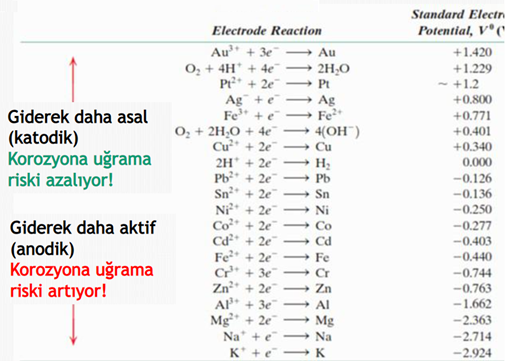
Metals are exposed to solutions that contain their own ions at unit activity. Their potential differences are stated in the standard electromotive-force series in the table. In this series the metals are ordered from the most noble to the most active.
If two different metals are connected electrically in an electrolyte, the more active metal becomes the anode of the corrosion cell. The standard electromotive-force series is a table arranged by the corrosion tendencies of metals.
Some water treatment products that Cemkimsan Kimya developed and that our factories produce:
CEFOPOL 1080; Multifunctional boiler water treatment chemical.
CEMOLİN 1080; NSF-approved corrosion inhibitor for the steam line, suitable for use in food production.
CK-13; Corrosion inhibitor in closed-loop heating and cooling systems.
CK-42; Corrosion inhibitor in closed-loop heating and cooling systems.
Source:
Cemkimsan lecture notes
https://www.kmo.org.tr/resimler/ekler/f51288c412df764_ek.pdf
http://dspace.yildiz.edu.tr/xmlui/bitstream/handle/1/10398/0042247.pdf?sequence=1&isAllowed=y
https://www.metalurji.org.tr/dergi/dergi155/d155_4548.pdf
Resul Ağbulut
Chemical engineer
Water treatment consultant
January / 2023
17.06.2025
In industrial plants, cooling towers are critical for continuity and efficiency of the process. One of the most important problems in these systems is…
15.05.2025
Water has a vital importance in industrial processes. Water is used in steam boilers, cooling systems, drinking-water supply and the production line. That use…

12.02.2025
The main purpose of steam boilers is to heat water, obtain steam, and use this steam as an energy source. These boilers are usually chosen in industrial…
We help you select the correct chemical for your system
Send us your feed water analysis or your requirement. Our technical team will send you a recommendation. +90 (216) 573 4014 · [email protected]