17.06.2025
Prevention of Biological Fouling in Cooling Towers:
In industrial plants, cooling towers are critical for continuity and efficiency of the process. One of the most important problems in these systems is…
 Request a quote
Company
About usDealershipCertificatesReferencesBlogSearch the siteContact
+90 (216) 573 4014[email protected]Heated water is spread evenly over the fill material in the cooling tower. Intense contact with air cools the water in two ways:
● 15-25% of the heat is by direct contact with cold air,
● The large remaining part is by evaporation of some of the cooling water. The difference between the heat of the water that enters the cooling tower and the heat of the water that leaves is expressed by ΔT.

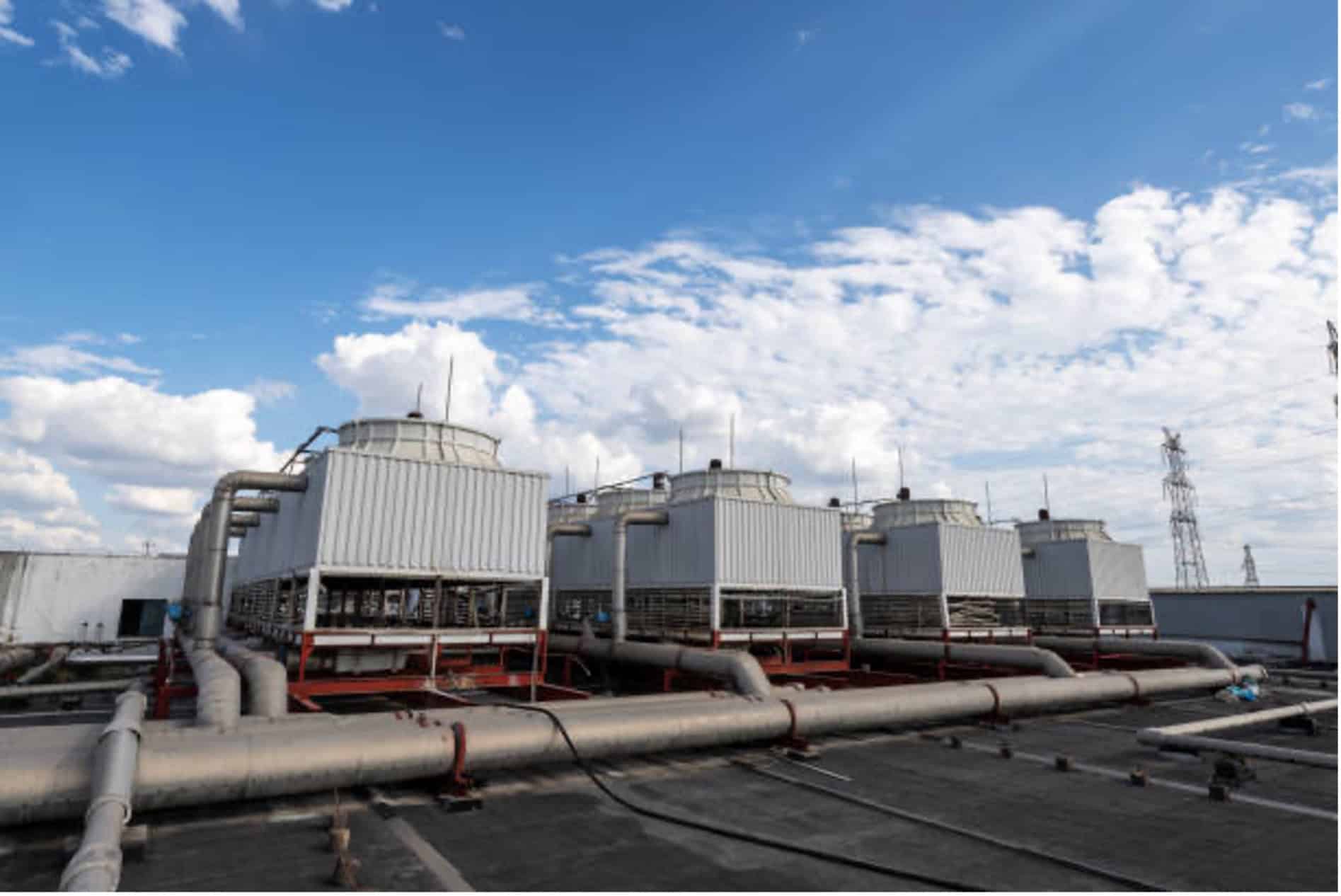
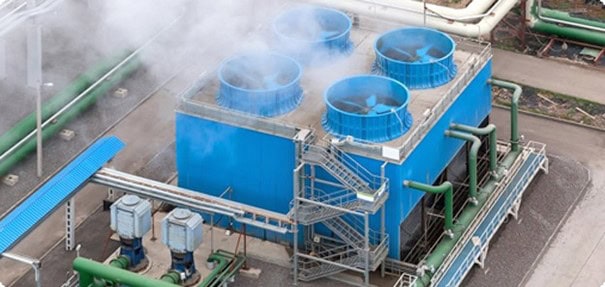
The “wet” type cooling towers used most commonly are natural-draft and mechanical-draft cooling towers. By the flow directions of air and water, they are also divided into cross-flow or counter-flow.
In natural-draft towers, the movement of air from the bottom upward takes place from the heat and density differences inside the cooling tower. In mechanical-draft towers, fans provide the air movement.
Power plants, because of the large amount of water to be cooled, use the most economical path: tall natural-draft cooling towers. Other industries use smaller and lower mechanical-draft cooling towers. When needed, they use several units at once.
Closed and semi-open cooling systems
In closed-loop cooling systems, unlike open circuits, hot water is cooled in heat exchangers. The heat exchanger can also be cooled by an open circuit or by an air-cooled closed loop.
Use of closed-loop cooling systems is common for cooling continuous-casting molds in steelworks. The work is at very high temperatures. Hardness precipitation would damage the molds. The molds are cooled by closed loops that use demineralized or softened water. Cooling of the plate heat exchangers that are used most often is done by a secondary evaporative open-circuit cooling system.
By structure, water losses in closed loops are very small. Demineralized or softened water is preferred to make up the shortage. Because these waters are very aggressive, the main target in water treatment is good corrosion inhibition. Treatment is usually without problems. Chemicals are fed in proportion to the fresh-water quantity. Because there is no evaporation, their concentrations in the cooling water do not change much.
Semi-open cooling systems are used where the process is hot for a short time. The quantity of heat to be lowered is small. From this, a closed-mouth tank is usually enough to cool the water. The size of the tank must provide the time to lose the required heat drop by radiation. Water losses are only evaporation and leaks that are not worth recording. As in closed loops, demineralized or softened water is also used in semi-open circuits. Examples of use of semi-open cooling circuits can be seen in cooling of electrical equipment, or of the quench water used in induction hardening. Unlike closed loops, oxygen works continuously into semi-open circuits and raises corrosivity all the time. As in induction hardening, galvanized corrosion must be taken into account.
Cooling-water problems
In heating systems, various precipitates form that are called stone or sediment. This formation can come from precipitation of dissolved salts, from settling of suspended matter, from microbiological growth, or from corrosion residues.
Besides scaling, materials that are in contact with water are open to the effects of corrosion. The reason is a corrosive water or bacteria that cause corrosion.
Scaling is the crystallization or precipitation of substances that were previously dissolved in the cooling water. The reason can be that the solubility limit is passed as a result of a rise in concentration, and/or a change in heat.
Calcium carbonate forms hard precipitates. It is the form of scaling met most often in cooling systems.
In general, this type of scaling comes from the reaction of dissolved calcium bicarbonate when the CO2 concentration falls.
In natural waters, the cations found most commonly are Ca2+ (calcium), Mg2+ (magnesium), Na+ (sodium) and K+ (potassium). Other alkali, alkaline-earth and other metal ions are also met in trace amounts.
Total hardness = calcium hardness + magnesium hardness
The components that cause hardness can be present as bicarbonate, carbonate, or other salts such as sulfate, chloride and nitrate. For this reason a further definition can be made as carbonate hardness and non-carbonate hardness. If the hardness components, for example calcium and magnesium bicarbonates and carbonates, are in the form of carbonic-acid salts, that is carbonate hardness. If calcium and magnesium ions are present as mineral-acid salts, that is called non-carbonate hardness.
In cooling systems, precipitation of various kinds of calcium sulfate is met. One of the most important is gypsum (CaSO4 x 2H2O). The solubility of gypsum increases up to 40°C. At higher temperatures it decreases. Under most cooling-water conditions, the solubility of gypsum is a hundred times the solubility of calcium carbonate, and more.
In most raw waters, especially in well waters, dissolved iron is present. If it is not removed by fresh-water preparation, it oxidizes in the cooling system. It will turn very quickly into iron hydroxide or iron oxide and will settle in large flocs.
Some water treatment products that Cemkimsan Kimya developed and that our factories produce:
CK 229: Phosphonate-based treatment chemical for scale and corrosion control in open and semi-open cooling towers. It breaks the crystal structure of minerals that cause scaling and makes them amorphous, so blowdown can remove them. It prevents corrosion on copper surfaces.
CK 429: All-organic treatment chemical for scale and corrosion control in open and semi-open cooling towers. It is effective at high pH values without the need to use acid. Its all-organic structure is friendly to the environment. It prevents corrosion on copper surfaces.
C BIOCIDE 886: Biocide designed for microorganism control in industrial process water in open cooling towers. It prevents the formation of moss, bacteria, and fungi. It prevents the blockage, contamination, and corrosion that this biological growth causes. You can use it safely on metal surfaces that contain copper.
CK 699: Auxiliary product used to adjust pH and alkalinity in cooling systems. It prevents the deposit problem that a high pH value causes.
CK – 180: An all-organic dispersant used for scale control in open cooling towers. It stops suspended solids from joining, settling and sticking to the metal. It prevents deposit formation in cooling towers. It provides clean surfaces so that corrosion inhibitors can reach the metal surfaces easily. When it is applied at high dosages, it also slowly cleans old precipitates.
Hakan ÇOBAN
Chemical engineer
Water treatment consultant
Source:
https://muhendislik.sdu.edu.tr/assets/uploads/sites/148/files/sogutma-kulesi-12022015.pdf
Chamber of Chemical Engineers of TMMOB, Water Handbook
Cemkimsan Kimya lecture notes
17.06.2025
In industrial plants, cooling towers are critical for continuity and efficiency of the process. One of the most important problems in these systems is…
15.05.2025
Water has a vital importance in industrial processes. Water is used in steam boilers, cooling systems, drinking-water supply and the production line. That use…
12.02.2025
The main purpose of steam boilers is to heat water, obtain steam, and use this steam as an energy source. These boilers are usually chosen in industrial…
We help you select the correct chemical for your system
Send us your feed water analysis or your requirement. Our technical team will send you a recommendation. +90 (216) 573 4014 · [email protected]