Search

Antiscalant

November 8, 2024

In reverse osmosis filtration systems, specific chemicals are added to the water to prevent the minerals that accumulate on the raw water side of the membrane from crystallizing. This practice extends the life of the filters and ensures more effective performance.

Reverse osmosis (RO) plays a critical role in freshwater production. However, mineral scaling is an inevitable problem in the RO process. To address this issue, various methods have been developed, such as pretreatment of feedwater, optimization of operational processes, development of new membrane materials, and the use of scale inhibitors. The addition of scale inhibitors stands out as a highly cost-effective and practical technique for controlling membrane scaling.

To effectively reduce scale formation on RO membranes, there is an urgent need to develop new, high-performance, and environmentally friendly scale inhibitors through an in-depth investigation of the inhibition mechanisms of antiscalants and robust structure-activity relationships. In practical RO processes, the optimization of combinations of scale inhibitors and other pretreatments is a fundamental element for effective scale control.

When the salt concentration increases and exceeds the solubility of poorly soluble salts, scale easily forms through bulk and surface crystallization, leading to membrane fouling and a decline in membrane performance. To reduce the risk of membrane scaling, numerous methods have been developed in accordance with the characteristics of RO systems, including feedwater pretreatment, optimization of operational processes, the development of new membrane materials, and the addition of scale inhibitors. Generally, pretreatment steps such as softening, pH adjustment, and the use of membranes with larger pore sizes are essential for reducing scale formation.

Adjusting the pH level of the feedwater is effective in reducing the formation of certain sparingly soluble salts, because the solubility of carbonate minerals and silica scale is directly related to pH.

The overall design of a RO system has a significant impact on its stable operation. Many factors—such as feedwater characteristics (pH, temperature, composition) and the selection and optimization of operational parameters (applied pressure, hydrodynamic conditions)—must be evaluated, taking into account the target recovery rate and membrane cleaning.

Although the addition of antiscalant reduces the volume of concentrate—especially at high water recovery rates—it is considered one of the most common methods for preventing scaling in the RO process due to its advantages of high efficiency, low cost, and ease of use.

For this reason, a comprehensive understanding of the effects and mechanisms of antiscalants in RO systems is of great importance in improving the performance and usability of antiscalants.

Why should an antiscalant be used?

  • When antiscalant is not used, poorly soluble salts accumulate on the membrane surface and form deposits. The most common types of deposits include calcium carbonate, calcium sulfate, barium sulfate, and strontium sulfate. Silica and calcium fluoride deposits may also occur at times.
  • When the precipitation process begins, the system's performance starts to decline gradually. However, as the amount of precipitate increases, a rapid decline in performance is observed. The rate of this decline varies depending on the type of precipitate.
  • Calcium carbonate-based deposits lead to a more rapid decline in performance compared to sulfate-based deposits. These deposits, which form on the membrane surface, cause a decrease in permeate flow and damage to the membranes.
Antiscalant
Antiscalant 2

Benefits of Antiscalant:

  • The need for sulfuric and hydrochloric acid decreases, which reduces the risks associated with these chemicals.
  • It results in lower operating costs and reduced maintenance and cleaning expenses.
  • It offers higher recovery rates in a reverse osmosis system.
  • The system can operate efficiently for a longer period of time.
  • It helps reduce the concentration flow rate and extend membrane life.

Antiscalant is added to the feedwater in membrane processes to delay the precipitation and crystallization points of salts present in the water. Thanks to its high capacity to dissolve lime and contaminants, it reduces fouling and extends the membrane’s service life.

When applied correctly, an antiscalant significantly delays crystallization, which in turn delays the onset of scaling. It results in lower operating costs and reduces maintenance and cleaning expenses. It provides higher recovery rates in reverse osmosis systems, helps the system operate efficiently for longer periods, reduces the concentrate flow rate, and extends membrane life.

Membranes that are clogged or have bacterial growth can be cleaned with special cleaning chemicals and made reusable.

Some ofthe antiscalants we have developed at Cemkimsan Kimya and manufacture at our plantsinclude:

C-SCALANT 2005: A membrane protection product. It prevents membrane clogging or a decrease in capacity and extends their useful service life.

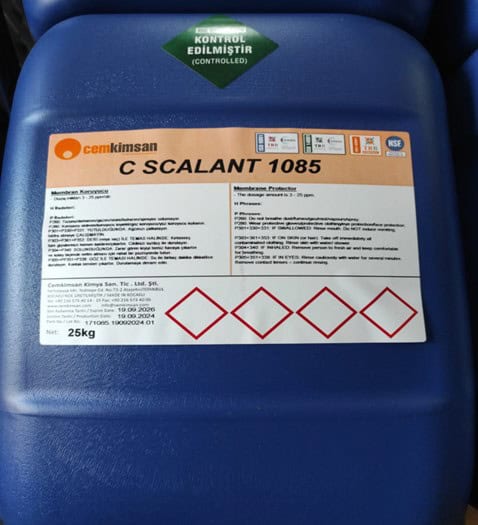
C-SCALANT 1085: A membrane protection product. It prevents membrane clogging or capacity loss and extends the useful service life of the membranes. Suitable for use in drinking water production facilities. NSF-certified.

C-MEC 100: An organic acidic membrane cleaner used to clean membranes whose pure water production capacity has decreased due to scale and similar contaminants. It is an acidic product with a low pH value.

C-MEC 200: Basic membrane cleaner; used to clean membranes whose pure water production capacity has decreased due to colloidal and similar contaminants. It is a basic product with a high pH value.

C-MEC 17: Membrane Disinfectant is a membrane cleaning chemical used to remove biological deposits that accumulate on R.O. membranes over time.

Hakan ÇOBAN

Chemical Engineer

Water Treatment Consultant

Source:

https://www.sciencedirect.com

https://www.suvecevre.com/edergi/19/149/index.html

TMMOB Chamber of Chemical Engineers Water Handbook

Cemkimsan Chemistry Lecture Notes