
Cooling tower: As water passes through the tower, part of it evaporates upon contact with the air and is released into the atmosphere; during this process, some of the heat from the cooling water is transferred to the atmosphere through evaporation, thereby cooling the water.
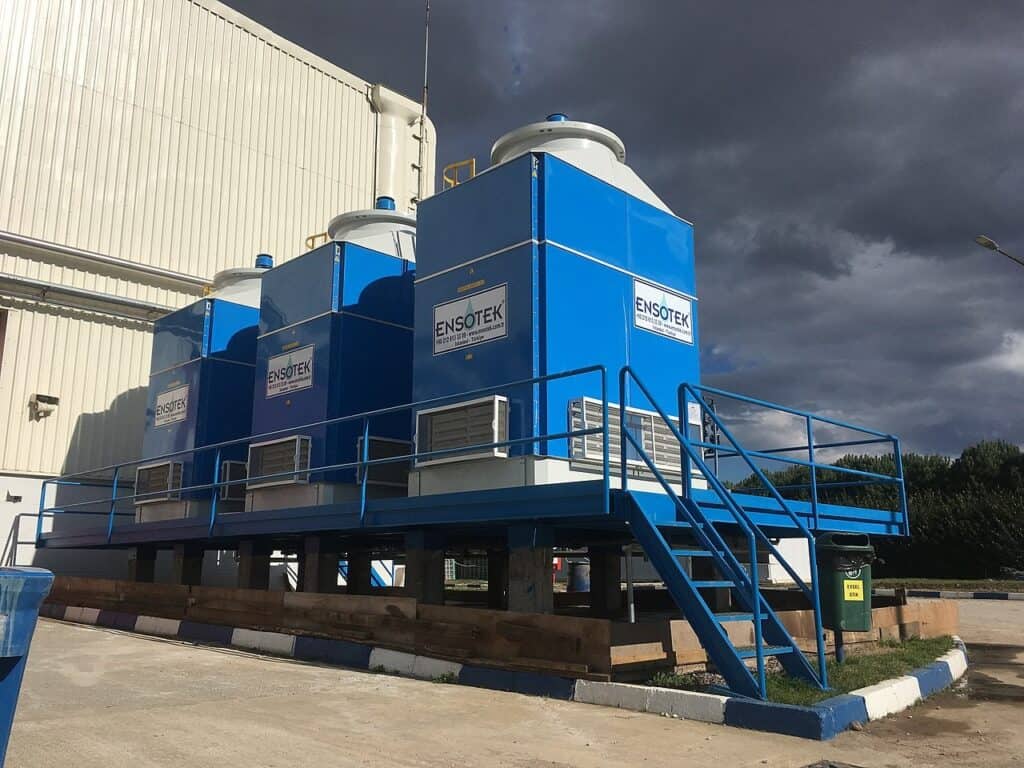
Water cooling towers are used in industrial facilities across all sectors and in HVAC systems to produce cooled water.
The operating principle of cooling towers is divided into two categories based on how water comes into contact with air:
- Counterflow cooling towers
- Cross-flow cooling towers
Soğutma Tipine Göre Kule Çeşitleri:
- Open-Loop Water Cooling Towers
Closed-Loop Water Cooling Towers
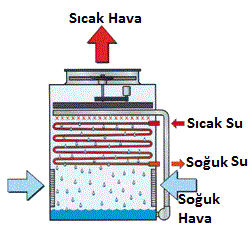
Scale, Corrosion, Biological Fouling, and Deposits in Cooling Towers
The deposition of salts dissolved in the water circulating through the system onto heat exchanger surfaces due to increases in temperature and concentration is referred to as scale formation.
Corrosion is an electrochemical process in which the anode—where metal dissolution occurs—and the cathode—where reduction occurs—are physically separated from one another.
The types of corrosion can be listed as follows:
Pitting (pitting corrosion): It is observed in areas where the water velocity is low. Once a pit forms in that area, water is diverted from the main flow and enters the pit.
Selective Dissolution: A type of corrosion that occurs in any alloy.
Galvanic Corrosion: Galvanic corrosion occurs when two different metals come into contact.
Erosion Corrosion: A type of corrosion caused by mechanical effects such as high water velocity and environmental factors.
In addition, deposits may form in the systems due to the following various reasons.
Iron in the feedwater, natural organic matter, dust carried by the air, soil, etc., sedimentation of solids, and corrosion products.
Biological contamination is present in all open cooling systems.
It is caused by microorganisms found in the environment and in water. It occurs as a result of sunlight and temperature. Sedimentation, clogging, algae growth, and bacterial growth increase in these systems. Bacteria live and reproduce in both natural and artificial aquatic environments. Bacterial populations decrease when the water temperature is below 20 °C; reproduction reaches its maximum level at 37 °C; it ceases at 46 °C; at higher temperatures, the population declines, with bacteria surviving for a few hours at 50 °C, a few minutes at 60 °C, and dying rapidly at 70 °C.
An open cooling tower is a system that promotes the formation of scale, deposits, and corrosion. In such systems, evaporation—the primary cooling mechanism—also acts as a mechanism that increases concentration. Since the water that evaporates is pure, the total dissolved solids (TDS) in the circulating water continuously increase. This leads to the saturation point being exceeded and the formation of scale.
The concentration factor plays an important role. Limiting the concentration factor prevents oversaturation. It also ensures that the chemical conditioning products used are utilized more effectively.
Corrosion Prevention Through Chemical Conditioning
The corrosion rate can be reduced by adding certain chemicals to a corrosive environment. These substances are generally referred to as corrosion inhibitors. Corrosion inhibitors are substances that significantly reduce the corrosion rate by preventing anodic and cathodic processes—or both—in the environment to which they are added.
An inhibitor that prevents corrosion of one metal may not have the same effect on another metal. A corrosion inhibitor appropriate for the type of metal and its environment must be used.
With the development of industry both globally and in our country, water-based heating and cooling systems have become an indispensable part of business operations. Water treatment is the most effective protective measure for preventing scale, corrosion, and microbial growth in these systems, as well as for reducing maintenance and operating costs.
In addition to ensuring that the chemicals used in water treatment programs are compatible with the system, it is also very important to support these programs with a regular monitoring schedule. Through these monitoring programs, systems should be inspected using both physical and chemical analysis methods. At the same time, system operation records—including meter readings, operating hours, and schedules—should be maintained. It is important to remember that nothing that cannot be measured can be improved.
It is important to involve water treatment companies during the project phase so that they can monitor the system and improve the quality of the program they will implement. Water treatment programs offer measures that save time, money, labor, and energy. Heating and cooling systems, steam systems, and process water systems are the mechanical systems where water is used the most. Keeping water-related issues such as corrosion, scale, and microbial growth under control in these systems will not only ensure a long service life for the systems but also prevent an increase in energy costs.
Some of the water treatment products we have developed at Cemkimsan Kimya and manufacture at our plants include:
CK 229: A phosphonate-based water treatment chemical used for scale and corrosion control in open and semi-open cooling towers. It disrupts the crystal structure of minerals that cause scaling, turning them into an amorphous state, and facilitates their removal through blowdown. It prevents corrosion on copper surfaces.
CK 429: A fully organic water treatment chemical used for scale and corrosion control in open and semi-open cooling towers. It is effective at high pH levels without the need for acid. Its fully organic composition makes it environmentally friendly. It prevents corrosion on copper surfaces.
C BIOCIDE 886: A biocide designed for controlling microorganisms in industrial process water in open cooling towers. It prevents the growth of algae, bacteria, and fungi. It prevents clogging, contamination, and corrosion caused by this biological growth. It can be safely used on metal surfaces containing copper.
CK 699: This is an additive used to regulate pH and alkalinity in cooling systems. It prevents scaling caused by high pH levels.
CK – 180: A fully organic dispersant used for scale control in open cooling towers. It prevents the formation of deposits in cooling towers by preventing suspended solids in the water from aggregating, settling, and adhering to metal surfaces. It ensures clean surfaces so that corrosion inhibitors can easily reach metal surfaces. When applied at high dosages, it also gradually removes existing deposits.
Hakan ÇOBAN
Chemical Engineer
Water Treatment Consultant
Source:
https://tr.wikipedia.org/wiki/So%C4%9Futma_kulesi
https://tr.wikipedia.org/wiki/Kapal%C4%B1_%C3%A7evrim_so%C4%9Futma_kulesi
TMMOB Chamber of Chemical Engineers Water Handbook
Cemkimsan Chemistry Lecture Notes