17.06.2025
Prevention of Biological Fouling in Cooling Towers:
In industrial plants, cooling towers are critical for continuity and efficiency of the process. One of the most important problems in these systems is…
 Request a quote
Company
About usDealershipCertificatesReferencesBlogSearch the siteContact
+90 (216) 573 4014[email protected]When the boiler is taken out of service, it is exposed to more rusting and corrosion than the corrosion that occurs during operation.
If water that has not been degassed, or that contains very little alkali, remains inside the boiler, the rate of rusting and corrosion rises.
Boilers for which enough protection measures have not been taken are exposed to corrosion even if the water is fully drained. It is possible to protect fully drained boilers against corrosion with very little effort.
During shutdowns, oxygen corrosion is met most commonly.
During shutdowns, low pH corrosion can also be observed.
A suitable preservation method must be applied against the corrosion mechanisms met during shutdowns.
Taking the steam boiler out of service
If the steam boiler will not be operated for a long time:
While the boiler steam outlet is reduced, the feed water must also be reduced and the flame must be made smaller. After the flame is extinguished, the shutoff valve at the steam outlet must be closed very tightly.
If the water level is normal, the feed-water pump must be stopped and the feed-water inlet valve must be closed.
If the water level is much higher than its normal value, blowdown must be done until it comes to normal. The boiler must then be left to cool.
To prevent different temperatures from occurring, fast cooling must be avoided.
Draining the steam boiler
When the boiler is left to cool, the fall of pressure is watched.
After no pressure remains in the boiler and the water temperature has fallen below 90 oC, the boiler can be drained.
It is also objectionable to drain the boiler too soon. The refractory mortar must first cool to a level that can be touched without burning the hand.
After the boiler is fully drained, the blowdown valves must be closed tightly. Warning labels that state they must not be opened must be hung on them.
Protection of the flue-gas side of the steam boiler
If the boiler will not be operated for a long time, protect it against rust and corrosion. The operations that must be done are these:
1. Clean the furnace, the flue tubes and the flue-gas side of the tube sheet. Do this until the boiler temperature falls to about 40 oC.
2. Oil all the surfaces on the flue-gas side in a thin layer.
3. The contact of the boiler with outside air must be cut completely.
4. Also, by placing vessels filled with half-burned lime, the air inside the boiler must be kept dry.
Wet-method preservation of the steam boiler
Boilers that will not be operated for a short time must be preserved by the wet method.
An oxygen scavenger is dosed at 5-10 times the dosage done during normal operation. After the pH adjustment is made, the boiler is left on standby.
The steam and water valves on the boiler are closed tightly.
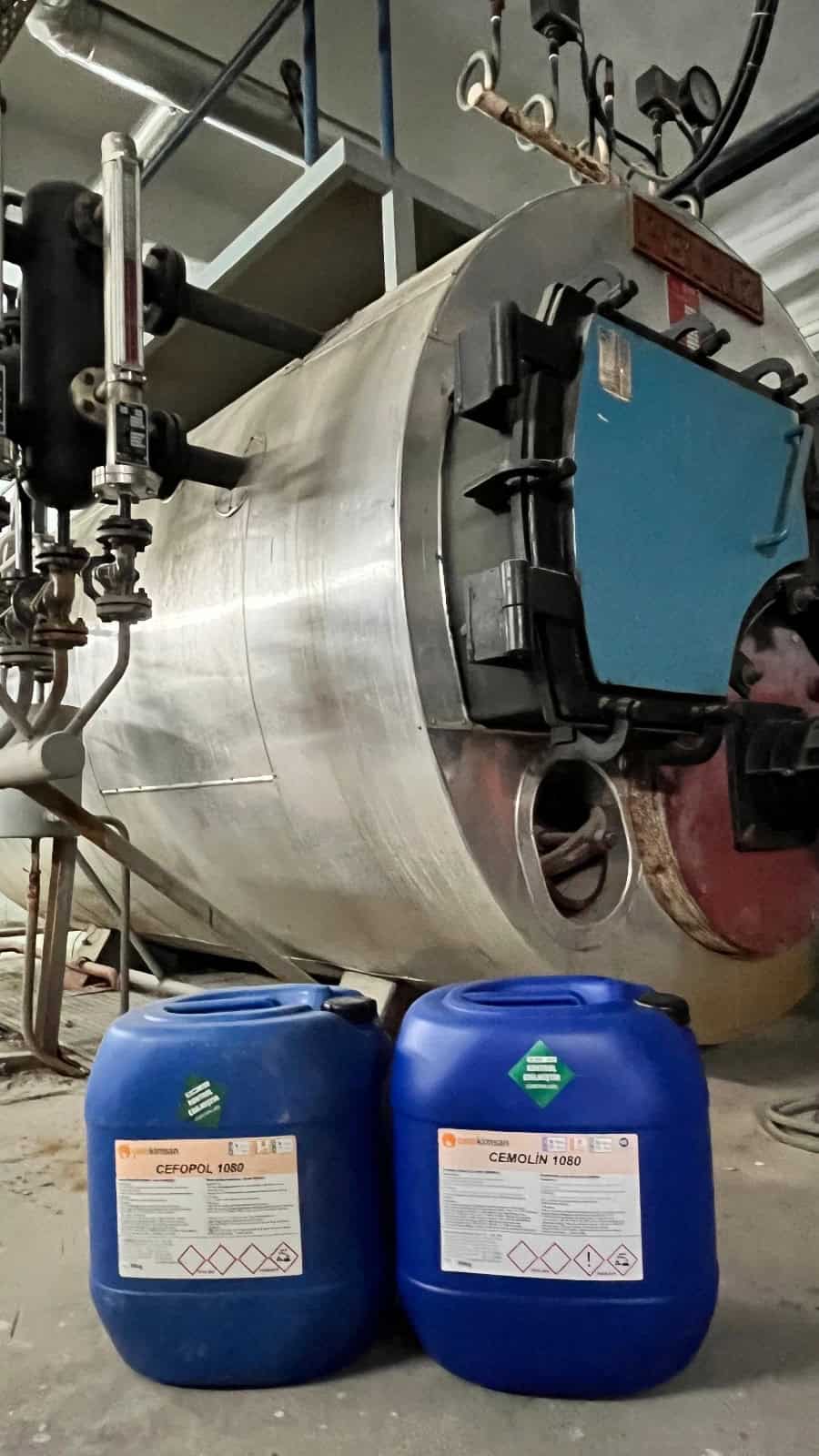
By giving CEFOPOL 1080 to the existing boiler water, the phosphate value is raised. CEFOPOL 4080 oxygen scavenger is mixed into the boiler water again. The dose is 5-10 times the dosage of normal operation. Safety measures against rusting and corrosion are taken. After the pH adjustment is made with CEFOPOL 4030, the boiler is left on standby.
* During shutdowns, oxygen corrosion is met most commonly.
(Dissolved-oxygen corrosion is the corrosion type met most in boiler operations. Its general appearance is widespread pits along the metal.)

* During shutdowns, low pH corrosion can also be observed.
(This is the corrosion type that the boiler water or the feed water forms because it does not have a suitable alkalinity or pH value. It is seen as a uniform thinning on the whole metal surface. It is removed by providing suitable pH values. For this purpose, substances such as amines, ammonia or caustic can be used. Especially in hot-water circuits, where alkalinity decomposition does not occur because carbon dioxide cannot stay free, pH adjustment must be done. In these systems, a pH value of about 10 is the most suitable solution.)
After chemicals are added to the steam boiler, set the safety valve to about 0.2 kg/cm 2. This is to discharge the remaining oxygen. Fill the boiler with water until it overflows from the safety valve.
After the boiler cools, it is filled with water, protective chemicals are added, and all valves are closed tightly.
In cold weather, the boiler-room temperature must not fall below +4 o C, so that freezing is prevented.
When the boiler will be taken into operation again, the boiler water must be partly drained from the blowdown valve. The boiler is then filled again up to the water level with normal feed water.
Dry-method preservation of the steam boiler
Boilers that will not be operated for a long time must be preserved dry.
While the boiler is hot and at low pressure, the boiler water is fully drained from the blowdown valve.
After the boiler is drained, the safety valve is opened and the steam is discharged.
All covers and valves on the boiler are opened, and it is checked whether the inside of the boiler has dried.
When needed, it is dried with something. Vessels filled halfway with chlorcalcium and or burned lime are put inside the boiler.
These vessels must be changed about once every 3 months.
A burning lamp must be placed inside the boiler to destroy the remaining oxygen.
Then all valves and the cover and valve openings must be closed.
The condition for dry preservation of the boiler to succeed is valves, handholes and flanges that can close with a full seal.

As CEMKIMSAN KİMYA, some of the steam-boiler treatment products that we developed and produce in our factory:
Cefopol 1080 (Multifunction boiler-water treatment chemical)
Cefopol 1040 (NSF-approved steam-boiler scale and corrosion inhibitor suitable for use in food production)
Cefopol 4030 (Steam-boiler alkalinity adjuster)
Cefopol 4080 (Corrosion inhibitor)
Cefopol 6035 (Hardness stabilizer and scale preventer for steam boilers that operate at high hardness)
Cefolin 1080 (Multifunction steam-boiler and steam-line scale and corrosion inhibitor)
Cemolin 1080 (NSF-approved steam-line corrosion inhibitor suitable for use in food production)
Source:
http://eng.harran.edu.tr/~hbulut/buhar.pdf
http://www1.mmo.org.tr/resimler/dosya_ekler/7737ef924014622_ek.pdf
CEMKIMSAN KİMYA lecture notes.
TMMOB Chamber of Chemical Engineers Water Handbook.
17.06.2025
In industrial plants, cooling towers are critical for continuity and efficiency of the process. One of the most important problems in these systems is…

15.05.2025
Water has a vital importance in industrial processes. Water is used in steam boilers, cooling systems, drinking-water supply and the production line. That use…
12.02.2025
The main purpose of steam boilers is to heat water, obtain steam, and use this steam as an energy source. These boilers are usually chosen in industrial…
We help you select the correct chemical for your system
Send us your feed water analysis or your requirement. Our technical team will send you a recommendation. +90 (216) 573 4014 · [email protected]