
Corrosion
Corrosion is an electrochemical reaction. DIN 50900 defines it as “a reaction between a metallic material and its environment that causes a measurable change in the material and impairs the function of a metal structural component or an entire system.”
In short, it is the process by which a material undergoes physical and chemical changes as a result of its interaction with its surroundings.
Pitting Corrosion
It is a form of corrosion that occurs when pitting forms in a very small area on a metal surface. The pits that form are often too small to be seen with the naked eye. The depth of the pits is generally equal to their diameter.
Pitting corrosion is the most dangerous type of corrosion. Although material loss is minimal, the equipment can be rendered inoperable in a short time. The interior of the pits that form is usually filled with corrosion products. For this reason, it is extremely difficult to determine the number and depth of the pits.
Pitting corrosion begins with an anodic reaction that occurs at any point on a metal surface. If the metal and environmental conditions are suitable, this anodic reaction rapidly continues through a series of self-sustaining autocatalytic reactions, leading to the formation of a pit at that point.
The figure shows the corrosion of a metal in an aerated sodium chloride solution. When the metal begins to dissolve in an anodic region, an oxygen reaction occurs on the surrounding surfaces. The metal ions produced by the anodic reaction cause an increase in positive charges in that region. As a result, chloride ions in the solution migrate toward that region. This leads to an increase in the concentration of metal chloride and hydrogen ions within the pit. This, in turn, causes the corrosion rate within the pit to increase even further. While anodic reactions proceed within the pit, cathodic reactions occur on the surrounding surfaces through the reduction of oxygen.
The slowing of pitting corrosion beyond a certain depth is explained as follows: The metal hydroxides formed as a result of corrosion gradually seal the mouth of the pit over time. In this situation, it becomes more difficult for chloride ions to reach the metal inside the pit. For this reason, pitting corrosion can occur only in stagnant solutions. Pitting corrosion typically occurs in areas where the flow velocity decreases, such as in pipes and tanks.
The type of metal also plays an important role in the formation of pitting corrosion. Metals and alloys that are prone to passivation are more susceptible to pitting corrosion. Pitting corrosion is particularly common in stainless steels. In fact, even mild steel is more resistant to pitting corrosion than stainless steels.
It is not accurate to assess pitting corrosion based solely on weight loss. Pitting corrosion is evaluated using statistical methods by measuring both the number and depth of pits. The average pit depth alone does not provide a clear indication of corrosion damage. What matters is the maximum pit depth, which can only be determined using statistical methods. The number of pits on a given surface follows a normal distribution based on their depths. Probability methods can be used to calculate the maximum pit depth or the number of pits at a specific depth.
Measures to Prevent Pitting Corrosion
Welding should be preferred over bolts and rivets.
The joints where the two plates meet should be sealed by welding or soldering.
It is of great importance to avoid using metals that are susceptible to pitting corrosion from the outset.
The use of inhibitors is also helpful in preventing pitting corrosion. However, if corrosion cannot be completely prevented by using inhibitors, this can lead to more dangerous consequences.
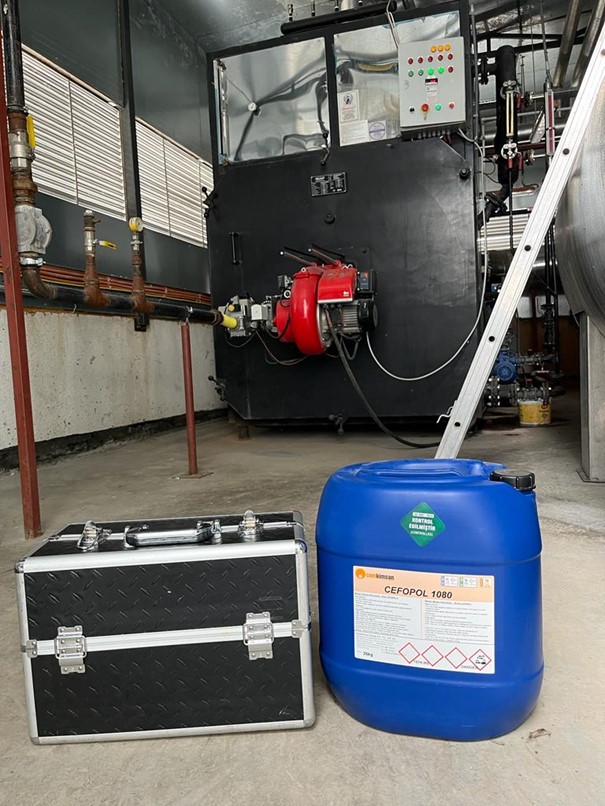
Some of the corrosion-inhibiting products we have developed at Cemkimsan Kimya and manufacture at our plants include:
CEFOPOL 1080; Multifunctional boiler water treatment chemical.
CEMOLIN 1080; An NSF-certified steam line treatment chemical suitable for use in food production.
CEFOPOL 4080; A corrosion inhibitor used in steam boilers.
CK-42; Corrosion inhibitor for closed-loop heating and cooling systems.
CK-13; Corrosion inhibitor for closed-loop heating and cooling systems.
Source
Cemkimsan Lecture Notes
https://www.taninmismakina.com/tesisatta-korozyon/
https://www.kmo.org.tr/resimler/ekler/f51288c412df764_ek.pdf