
How Does Scale Form in a Steam Generator Coil?
A layer of limescale forms on the surfaces where heat transfer occurs.
Systems used for steam production, such as steam boilers and steam generators, frequently experience problems with scale buildup.
To prevent scale buildup, a good pretreatment system is essential.
A chemical conditioning program must be implemented to capture hardness components that escape from the treatment system and to prevent corrosion.
In treated water, the hardness level and other chemical parameters must be periodically monitored and recorded.
As a result of scale buildup, the pipes in steam generator systems become narrowed or clogged. Chemical cleaning procedures should be performed on the steam generator before clogging occurs.
What Are the Harmful Effects of Scale Formation in a Steam Generator System?
A layer of lime acts as a good insulator and provides good resistance to heat transfer. A 1-mm layer of lime increases fuel costs by 5–8 percent, depending on its composition.
Gases such as oxygen and carbon dioxide are also present in water in a dissolved state. At high temperatures, these gases separate from the water and become trapped in the scale that accumulates on heat transfer surfaces. Beneath the scale layer, oxygen causes pitting corrosion.
The scale layer is not uniformly distributed across all surfaces. While the thickness may be 1 mm in some areas, for example, it can reach 4 mm in other areas. In this case, different heat transfer coefficients will develop in different parts of the boiler, resulting in varying thermal stresses. This will cause rapid metal fatigue in the coil and lead to the degradation of the metal’s crystalline structure.
Excessive scale buildup will reduce the pipe diameter, negatively affect water and steam flow, and ultimately lead to blockages.
How Should Chemical Cleaning Be Performed on a Steam Generator Coil?
1. All valves in the generator system are closed.
2. Piping connections are installed between the generator system and the wash tank to facilitate circulation. The return water is fed into the wash tank.
3. Fill the wash tank with 45 liters of water.
(The washing process begins with a 10% chemical solution.)
4. The circulation pump is started.
5. Add 5 kg to the dosing tank during circulation CAS SCALE EASY is slowly added to the dosing tank.
6. Changes in FOAMING, TURBIDITY, and FLOW RATE are observed in the recirculating water; pH changes are monitored using pH strips. If necessary CAS SCALE EASY is added.
7. The pH value is monitored every 10 minutes. The pH value is maintained at a minimum of 2–3; as the pH increases, CAS SCALE EASY is added.
8. The chemical wash should last no more than 4–6 hours.
9. In the rinse water, the chemical washing process is complete when foaming stops and the pH value stabilizes at 2–3.
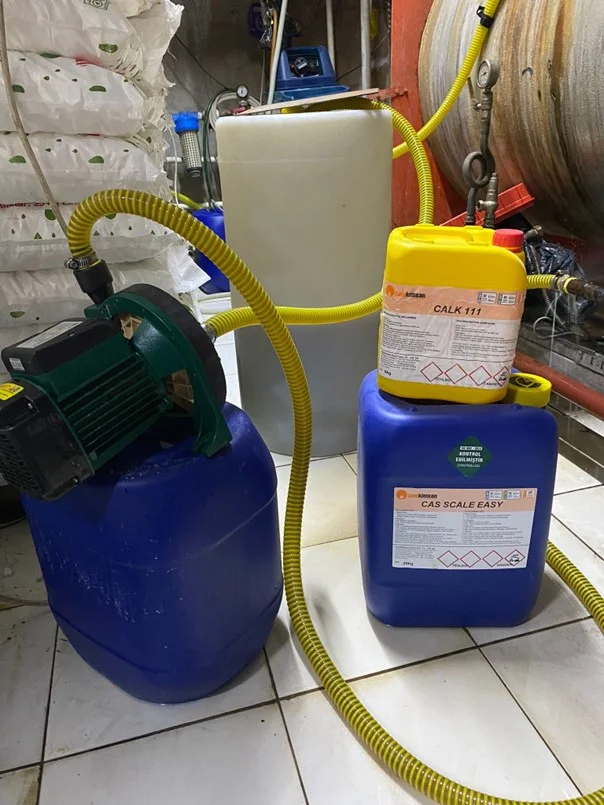
10. The chemical wash water is drained, and the neutralization process begins.
11. Add 45 liters of fresh water to the wash tank and start circulation. Add 0.5 kg CALK 111 is added to the circulating water. Circulation is maintained for 15 minutes.
12. Add 0.5 kg to the rinse circulation water CALK 111 to the rinse circulation water, and circulation is performed. Subsequently, a feed-and-drain cycle is performed using fresh water until the pH value reaches the 7–9 range.
Some of the water treatment products we have developed at Cemkimsan Kimya and manufacture at our plants include:
CEFOPOL 1080; Multifunctional boiler water treatment chemical.
CEMOLIN 1080; An NSF-certified steam line corrosion inhibitor suitable for use in food production.
CALK 111; Neutralizing chemical.
CAS SCALE EASY; An acid-based product used to remove scale and mineral deposits formed in cooling systems, steam and hot water boilers, heat exchangers, evaporators, and on the seawater side of cooling towers. It is used to clean heavy and stubborn scale deposits. It contains metal-protecting inhibitors.
Resul AĞBULUT
Kimya Mühendisi
Su Şartlandırma Danışmanı
Source:
Cemkimsan Chemistry Lecture Notes