
Although the word "stone" appears in its name, it does not analyze stone structures.
It is an acidic mixture generally used to remove limescale and corrosion deposits caused by water in heat exchanger systems (steam boilers, heat exchangers, water heaters, evaporators, etc.).
It is also used to clean metal and ceramic surfaces.
The chemical composition of stone acid varies. The appropriate type of stone acid should be selected based on the type of lime and contamination.
The acidic compounds that make up mineral acid are generally hydrochloric acid, hydrofluoric acid, and sulfamic acid.
Hydrochloric Acid (HCl)
Hydrogen chloride is a strong acid. Hydrogen chloride, which has a very simple molecular structure, consists of one chlorine atom and one hydrogen atom, and its formula is HCl. At room temperature, hydrogen chloride dissolves in water at a very high rate—approximately 450 liters per liter of water.
Hydrochloric acid, despite the benefits it offers, is a toxic substance and causes significant damage to most surfaces, particularly human tissue. For this reason, safety precautions must be maintained at the highest level when working with this acid. In addition to being toxic, the acid is irritating to the eyes and skin, causes burns on the skin, and is irritating to the respiratory system.
As is typical of acids, hydrochloric acid reacts with many metals —such as zinc, iron, magnesium, or aluminum —to release hydrogen. Copper reacts with this acid only in the presence of oxygen from the air; however, no hydrogen is released. Although gold and platinum do not react with hydrochloric acid, they dissolve in “aqua regia” (a mixture formed by combining hydrochloric acid and nitric acid in a 3:1 ratio), which affects nearly all metals.
Carbonates react vigorously with hydrochloric acid, releasing carbon dioxide.
Hydrochloric acid is widely used in the home for cleaning toilets and bathrooms. It is highly effective for polishing tiles. In addition, it is used in many fields, including PVC, iron and steel, organic material production, resin regeneration, pharmaceuticals, paints, paper, textiles, metal chloride production, additive production in the food industry, inorganic material production, pH control, ion exchange regeneration, and leather processing. Hydrochloric acid is also injected into rocks for oil exploration.
Hydrofluoric Acid (HF)
This is the name given to an aqueous solution ofhydrogen fluoride. It is used primarily in the glass processing industry. Because it has a corrosive effect on glass, it cannot be stored in glass bottles. It is a clear liquid and is designated as HF.
Extreme caution must be exercised when using it. Inhalation can lead to serious poisoning, while skin contact can cause severe burns. Compared to hydrogen atoms, it bonds more easily with carbon atoms and has a dissolving effect on animal tissues. Work with anhydrous hydrogen fluoride and hydrofluoric acid must be conducted exclusively in a fume hood, and gloves, as well as safety goggles or a face shield, must be worn.
Using hydrofluoric acid—which is frequently used for household cleaning—in combination with bleach can cause poisoning. Today, hydrofluoric acid is used in virtually all fields, ranging from PVC to iron and steel, and from the production of organic materials to the food industry.
Sulfamic Acid (H₃NO₃S)
It is a colorless, dry, non-volatile, non-hygroscopic, stable solid. It is an inorganic sulfide acid. Sulfamic acid is soluble in water and, when mixed with strong mineral acids, forms a strongly acidic aqueous solution; however, it can be safely handled and stored in its dry form.
Sulfamic acid is used in industrial cleaning and maintenance applications as a scale remover, cleaner, and rust and scale remover. It is also used in the textile industry, in tanning, in electroplating, in papermaking, and in metal filtration.
Sulfamic acid is preferred for household use over hydrochloric acid. If accidentally mixed with hypochlorite-based products such as bleach, it does not produce chlorine gas, unlike most other acids.
The benefits of using sulfamic acid include its ease of use, solubility, and low corrosiveness.
The our tartaric acid products;
CAS 16 – Lime Remover for Precious Metals
CAS 16 tüm ısıtma ve soğutma sistemlerinde oluşan kireç tabakası ve mineral tortuların temizliğinde kullanılan organik asidik toz üründür. Metal koruyucu inhibitör içerir. Çinko, alüminyum, paslanmaz çelik, galvaniz gibi hassas metallere zararı minimuma indirilmiştir.
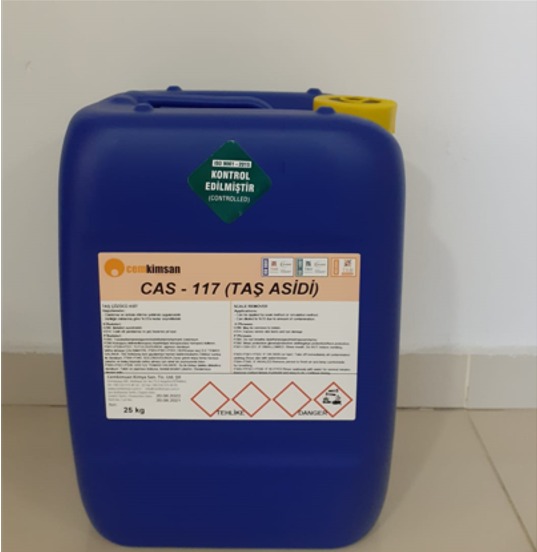
CAS 117 tüm ısıtma ve soğutma sistemlerinde oluşan kireç tabakası ve mineral tortuların temizliğinde kullanılan asit bazlı üründür. Yoğun ve inatçı kireç tabakalarının temizliğinde kullanılır. Metal koruyucu inhibitörler içerir.
CAS 167 – Copper-Specific Stone Acid
CAS 167 is an acid-based product used to remove limescale and mineral deposits from all heating and cooling systems. It contains a metal-protecting inhibitor. Damage to sensitive metals such as zinc, aluminum, stainless steel, and galvanized steel is minimized.
CAS 179 – Silica-Based Lime and Scale Remover
CAS 179 is an acid-based product used to remove silica-based scale and mineral deposits from all heating and cooling systems. It is used to clean heavy and stubborn silica deposits. It contains metal-protecting inhibitors.
CALK 111 – Neutralizing Chemical
CALK 111 is a product used for neutralization in heating and cooling systems that have undergone acid cleaning. It stabilizes the corrosive environment caused by low pH by raising the pH level of the water in the systems.
TMMOB Chamber of Chemical Engineers; Water Handbook
Cemkimsan Chemistry Lecture Notes
https://tr.wikipedia.org/wiki/Hidroklorik_asit