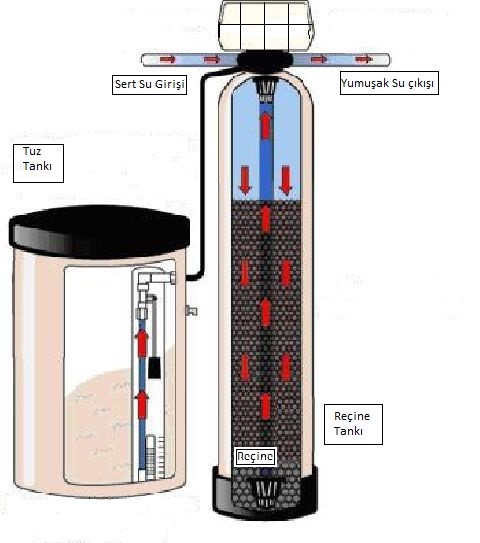
A water softening system is a process used to reduce water hardness. Hard water contains high levels of calcium and magnesium ions, which can cause various problems. The water softening process is typically carried out using resins. These resins attract the hardness ions in the water and replace them with sodium ions. As a result, the water becomes softer and more suitable for daily use. Water softening systems play an important role in a wide range of applications, from industrial uses to household use, and improve the quality of life by enhancing water quality.
Iron Contamination: Ion-exchange resins remove not only hardness ions but also iron ions present in raw water or coming from the pipes. However, iron ions cannot be removed from the resin during backwashing because the bonds they form are too strong to be broken by backwashing. To eliminate this problem, known as iron contamination, the resins must be flushed with certain special chemicals. If these chemicals are used on a weekly basis for maintenance and protection, the resins’ efficiency will increase, resulting in a significant reduction in salt consumption.
Dealkalization: This process is used to reduce the alkalinity of water with high alkalinity to a specific level. Alkalinity can be reduced using strong anionic ion-exchange resins or the lime-soda method, which is no longer widely used.
Demineralization: The process of removing all ions from water by passing it through strong cationic and strong anionic ion-exchange resins.
Carbon Removal: The process of mechanically removing gases—such as oxygen or carbon dioxide—that are dissolved in water .
Pre-Wash Process:
In newly established facilities, this process involves washing pipes and metal surfaces with a weak acid containing an inhibitor or with special polymers—depending on the degree of contamination—to remove corrosion residues formed during assembly, welding slag, sediment left behind by water during leak testing, and construction debris such as concrete and plaster from the system. When performing acid cleaning, acid inhibitors should be used to reduce the acid’s effect on the metal. Acid inhibitors come in different types depending on the acid used; they minimize acid corrosion by forming a protective film on the cleaned metal surfaces and raising the activation energy required for the acid-metal reaction.
Water softeners soften water by replacing the hardness ions in the water with sodium ions. This process extends the life of plumbing systems while making water use more efficient. It also helps detergents and cleaning products work more effectively, thereby reducing consumption.
Water softening systems, used in a wide range of applications from industrial facilities to residential buildings, improve water quality and enhance the overall performance of systems. In addition, regular maintenance and proper water softening reduce the risk of corrosion and minimize equipment failures. As a result, water softening systems are a key component that increases the efficiency of plumbing systems from both an economic and operational standpoint.
Corrosion Prevention Through Chemical Conditioning
Chemicals added to corrosive environments play an important role in reducing corrosion. These substances are generally referred to as corrosion inhibitors. Corrosion inhibitors are compounds that significantly reduce the rate of corrosion by inhibiting anodic and cathodic processes in the environment in which they are present.
An inhibitor that is effective for one metal may not have the same effect on another metal. Therefore, it is critical to select corrosion-inhibiting agents that are appropriate for the type of metal and the environment.
Today, with the advancement of industry, heating and cooling systems have become indispensable components of businesses. Protecting these systems against corrosion, scaling, and microbial growth through water treatment methods is one of the most effective ways to reduce maintenance and operating costs.
The suitability of the chemicals used in water treatment programs must be supported by regular monitoring programs. This monitoring ensures the control of the systems through physical and chemical analysis methods. In addition, the system’s operational data, meter readings, and operating times must be recorded regularly. It is important to remember that nothing that is not measured can be improved.
It is important to involve water treatment companies in the process during the project phase so that they can monitor the system and enhance the effectiveness of the program they will implement. Water treatment programs offer measures that result in savings in time, cost, labor, and energy. Heating and cooling systems, as well as steam and process water systems, are the mechanical systems where water is used most intensively. Keeping corrosion, scaling, and microbial growth under control in these systems not only extends their service life but also prevents energy costs from rising.
Some ofour water treatment products, which we developed at Cemkimsan Kimya and manufacture at our plants;
C-SCALANT 1085:A membrane protection product. It prevents membrane clogging or capacity loss and extends the useful service life of the membranes. Suitable for use in drinking water production facilities. NSF-certified.
Cefopol 1080:A multifunctional boiler water treatment chemical.
Cefopol 1040 :Multifunctional steam boiler scale and corrosion inhibitor
CK 229: A phosphonate-based water treatment chemical used for scale and corrosion control in open and semi-open cooling towers.
C BIOCIDE 886: A biocide designed for controlling microorganisms in industrial process water in open cooling towers.
CK-42; Corrosion inhibitor for closed-loop heating and cooling systems.
CK-13; Corrosion inhibitor for closed-loop heating and cooling systems.
Hakan ÇOBAN
Chemical Engineer
Water Treatment Consultant
Source:
http://dspace.yildiz.edu.tr/xmlui/bitstream/handle/1/10398/0042247.pdf?sequence=1&isAllowed=y
TMMOB Chamber of Chemical Engineers Water Handbook
Cemkimsan Chemistry Lecture Notes