
Corrosion
Corrosion is an electrochemical reaction. DIN 50900 defines it as “a reaction between a metallic material and its environment that causes a measurable change in the material and impairs the function of a metal structural component or an entire system.”
In short, it is the process by which a material undergoes physical and chemical changes as a result of its interaction with its surroundings.
Intergranular Corrosion
Metals exist in a solid crystalline state. Metal atoms are evenly distributed within this crystalline structure. Iron and steel have a body-centered cubic crystal structure. Austenitic stainless steels have a face-centered cubic crystal structure. Crystal structures play a role in intergranular corrosion of metals.
When metals are melted and left to cool, they solidify into adjacent crystals. The grains, which consist of numerous crystals, are separated from one another by grain boundaries. In the narrow regions between the grains, the crystal structure is disordered. These regions are where the metal is most susceptible to corrosion.
Intergranular corrosion occurs due to any impurity present between grains, such as an excess or deficiency of an alloying element. For example, even a small amount of iron in aluminum can cause intergranular corrosion. This is because iron is only slightly soluble in aluminum, so it accumulates between the grains. Similarly, in stainless steels, the chromium content is very low at the grain boundaries. These areas are susceptible to intergranular corrosion due to the lack of chromium.
Source Decay
The reason why stainless steels should not be welded is intergranular corrosion.
This phenomenon is known as source decay.
The temperature rises in the welded area, and chromium carbide precipitates form between the grains. Areas affected by the heat become susceptible to corrosion. During welding, not only the temperature itself but also the duration of heat exposure is important. This duration also depends on the thickness of the material being welded. For example, thin sheets are welded quickly and lose their heat just as quickly. This duration is not sufficient for the chromium carbide compound to form and accumulate between the grains. Consequently, weld corrosion does not occur in this case. For this reason, electric welding is more suitable for stainless steels.
The following three methods are used to minimize intergranular corrosion in austenitic stainless steels.
1. Heat treatment,
2. The addition of elements—known as stabilizers—to the alloy that form a durable carbide compound,
3. Reducing the carbon content in stainless steel to below 0.03%.
In practice, the first method is used most often. After the steel is heated to approximately 1100 °C for heat treatment, it is immersed in water (or a suitable oil) to cool it rapidly. At this high temperature, the chromium carbide compound is still in a dissolved state within the steel. Rapid cooling ensures a homogeneous distribution of the alloy.
In the second method, a small amount of metals such as titanium and columbium is added to the stainless steel to stabilize the carbon in the form of carbide compounds.
In the third method, the carbon content in the stainless steel is reduced to below 0.03%. This is how 304L-grade stainless steel is produced. This type of stainless steel is referred to as ELC (Extra-Low-Carbon) steel.
In standard 18-8 stainless steels, the carbon content is around 0.20%. It is easy to reduce this value to as low as 0.08% using any method. However, reducing the carbon content to even lower levels requires the use of specialized methods.
Knife-Edge Effect
In a narrow region on both sides of the welded shadow, a corrosion phenomenon similar to intergranular corrosion occurs along a long line. This is called the knife-edge effect. This effect does not occur in the welded joint itself, but along a line immediately adjacent to it. This effect occurs in stainless steels that have been stabilized against weld corrosion. The primary cause of this is the precipitation of carbides—formed by the metal added to the steel as a stabilizer—between the grains in regions where the temperature is low. The knife-edge effect appears along the line where the molten and unmelted regions meet during welding. The solubility temperatures of metal carbides in steel are listed below.
Temperatures Dissolution or Precipitation
At 1250 °C, chromium carbide and columbium carbide are in the molten state.
At 800 °C, columbium carbide precipitates, and chromium carbide dissolves.
At 500 °C, chromium carbide precipitates.
25 °C: Nothing happens.
These values indicate that austenitic stainless steel becomes sensitized when heated to temperatures between 500 and 800 °C. If the steel contains columbium, sensitization does not occur in this case. However, the knife-edge effect does become apparent.
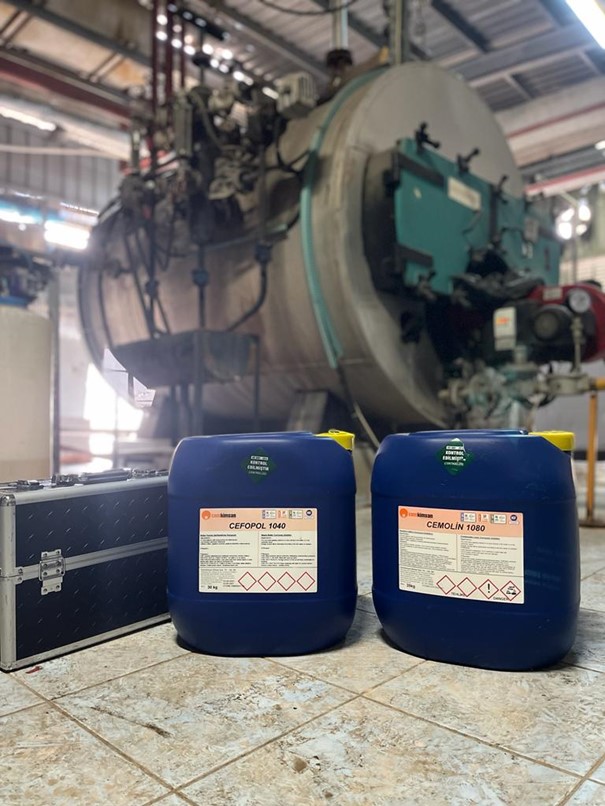
Some of the corrosion-inhibiting products we have developed and manufacture at our facilities include:
CEFOPOL 1080; Multifunctional boiler water treatment chemical.
CEMOLIN 1080; An NSF-certified steam line treatment chemical suitable for use in food production.
CEFOPOL 4080; A corrosion inhibitor used in steam boilers.
CK-42; Corrosion inhibitor for closed-loop heating and cooling systems.
CK-13; Corrosion inhibitor for closed-loop heating and cooling systems.
Source:
Cemkimsan Lecture Notes
https://www.taninmismakina.com/tesisatta-korozyon/
https://www.kmo.org.tr/resimler/ekler/f51288c412df764_ek.pdf