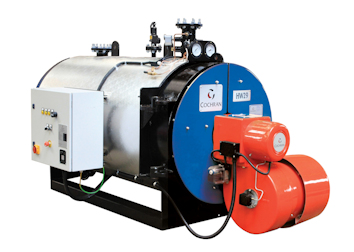
Conventional hot-water heating systems are designed as standard for water temperatures of 90/70 degrees Celsius. Over time, rising fuel costs and the growing importance of energy conservation have brought efficiency to the forefront in heating systems. Accordingly, systems operating at lower temperatures—70/55 degrees Celsius—are becoming increasingly common. In these systems, not only is efficiency higher due to the lower water temperature, but comfort levels are also higher.
A hot water system generally consists of a hot water boiler, water-carrying pipes, heating elements, a circulation pump, an expansion tank, a safety valve, automatic control devices, and various fittings and components.
The hot water produced in the hot water boiler is transported through pipes to heating elements—such as radiators, convectors, and hot-air units—installed in the areas to be heated.
In older systems, water circulation occurs naturally (by gravity), while in newer systems, it is provided by circulation pumps because this is more economical and convenient. Circulation pumps must be installed in the supply line.
The increase in volume that occurs as the water in the system heats up is collected in a reservoir called an expansion tank; while older systems used expansion tanks open to the atmosphere, newer systems use membrane-sealed expansion tanks that are closed to the atmosphere.
Hot-water systems are classified into the following categories based on various criteria:
a. By circulation type: natural circulation, pumped circulation.
b. Based on the size of the application: radiators, central block heating, district heating.
c. Expansion tank, according to Gore: open or closed expansion tank.
d. Based on the piping system: single-pipe, double-pipe
e. Based on the method of distribution and collection: bottom-up distribution and collection, top-down distribution and bottom-up collection.