
Corrosion:
Corrosion is a natural process that occurs when metallic materials react with their surrounding environment, without the need for external energy input. Most metals are not resistant to the effects of water and the atmosphere and can corrode even under normal conditions.
Hydrogen Embrittlement:
Hydrogen atoms form on the metal surface as a result of a corrosion reaction or during cathodic protection. These are absorbed by the metal surface.
Some of these atoms combine to form H₂ through the reaction H + H = H₂, and are released into the atmosphere as hydrogen molecules.
Some of the hydrogen atoms also enter the metal lattice and settle into the vacancies there.
Subsequently, these hydrogen atoms also transform into molecules, causing a significant increase in volume. Hydrogen in its molecular form no longer has the ability to diffuse.
Hydrogen molecules present in the metal create high pressure within the metal’s voids, causing the metal to crack. A hydrogen atom can cause cracking and fracturing in many ways.
Hydrogen produced by corrosion, hydrogen generated by cathodic protection, hydrogen produced during the pickling process, or hydrogen generated during welding with a wet electrode can cause problems for the metal.
It occurs more frequently in metals with a body-centered cubic lattice structure.
It is commonly found in the petroleum and chemical industries.
The hydrogen formed as a result of the cathode reaction creates pressure zones within the material, leading to internal stresses and cracks. Hydrogen atoms that have penetrated the iron cause fracture with a slight delay. This phenomenon is clearly observed in the tensile strength test.
If a sample susceptible to hydrogen damage is subjected to a tensile strength test, it will not fracture even if the normal tensile strength is slightly exceeded. However, fracture occurs suddenly after a delay of a few hours. A certain amount of time must elapse for hydrogen atoms to diffuse into the metal.
When welding with a wet electrode, hydrogen is released in atomic form.
The reaction is as follows: Fe + H₂O → FeO + 2H
The atomic hydrogen produced by this reaction diffuses into the structure of many metals, particularly α-iron. If the metal in question is not under load, some of the hydrogen that has entered the metal’s structure escapes without causing any damage to the metal.
At normal temperatures, hydrogen becomes inert after 48 hours.
Some of the hydrogen, however, never leaves the metal.
However, if the metal is heated to a high temperature for a short time, this hydrogen can be removed.
Measures to Prevent Hydrogen Embrittlement:
The following measures can be taken to eliminate or reduce the harmful effects of hydrogen penetration:
1. Hydrogen atoms that have penetrated the metal can be removed by heating the metal to a temperature of 100–150°C.
2. Hydrogen embrittlement occurs more frequently in high-strength steels. The resistance to hydrogen embrittlement can be increased by adding nickel or molybdenum to the steel.
3. As a general rule, hydrogen evolution on the metal surface should be prevented. For example, welding should not be performed on wet surfaces. In cathodic protection, excessive voltage should be avoided.
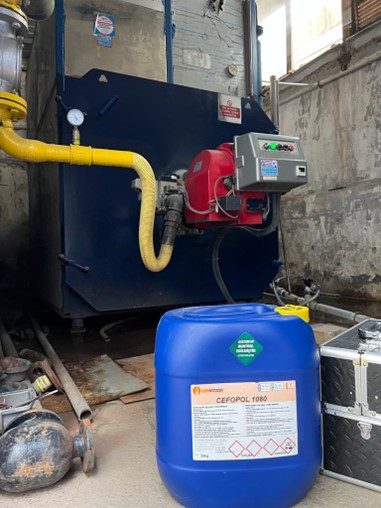
Some of the corrosion-inhibiting products we have developed at Cemkimsan Kimya and manufacture at our plants include:
CK-42; Corrosion inhibitor for closed-loop heating and cooling systems.
CK-13; Corrosion inhibitor for closed-loop heating and cooling systems.
CEFOPOL 1080; Multifunctional boiler water treatment chemical.
CEFOPOL 4080; Corrosion inhibitor used in steam boilers.
CEMOLİN 1080; NSF-approved steam line treatment chemical suitable for use in food production.
Source:
Cemkimsan Lecture Notes
https://www.taninmismakina.com/tesisatta-korozyon/
https://ww.kmo.orgtr/resimler/ekler/f51288c412df764_ek.pdf
https://www.dokumtek.com/hidrojen-kirilganligi-nedir/
https://web.itu.edu.tr/gulmezt/MekanikD/Metallerde%20Gevreklesmeler.pdf
http://w3.bilecik.edu.tr/makine-en/wp-content/uploads/sites/119/2016/12/Korozyon-deney.pdf