What Is Flushing?
Literally, it means washing with a large amount of water and auxiliary chemicals. In construction and mechanical engineering literature, “flushing” is specifically defined as the initial washing method applied to closed-loop systems.
Flushing is studied in two groups;
- Dynamic Flushing
- Dry Cleaning
- Dynamic Flushing
The primary purpose of the flushing process is to minimize the risk of system blockages and to remove as much contamination and waste as possible from the piping system to ensure a successful chemical cleaning operation.
Before dynamic flushing, it is important that all bypass lines be designed and installed in accordance with system flow rates, and that the discharge and fill ports be designed to allow for rapid filling and draining.
- Dry Cleaning
Flushing, which literally means “washing with a large amount of water and auxiliary chemicals,” is a term used in construction and mechanical engineering literature to describe the initial flushing procedure performed on closed-loop systems.
The flushing procedure does not serve a purpose on its own; rather, it is a preparatory step for the Chemical Protection Program.
What is the purpose of flushing?
- Pipes made of metal are coated with various oily protective substances to protect them from the oxidizing [corrosive] effects of moisture and O2 in the air during the manufacturing process, the forming stage, and storage.
- The oily film on the inner surface of the pipes that make up the closed-loop system traps the chemical composition present in the water, leading to sludge buildup within a short period of time.
- Depending on the structural characteristics of the mechanical system and the chemical composition of the water, the sludge that forms over time transforms into solid-phase stratification.
- Welding slag generated during the mechanical piping fabrication process, along with iron deposits and inorganic dust and particles originating from the construction environment, remain inside the piping system.
- These particles are carried along by the pressurized water within the system and accumulate at the connection points of devices such as pumps, heat exchangers, coil boilers, valves, and similar equipment, as well as inside them and in their fittings.
- Solid-phase layering and deposits accelerate the formation of various types of corrosion; this, in turn, reduces the heat transfer rate and disrupts the fluid flow regime [laminar → turbulent, vortices, pressure waves, etc.].
- As a result of these factors, not only does the operational efficiency of the devices and equipment in the mechanical systems decrease significantly, but their useful service lives are also shortened, leading to their decommissioning. Consequently, along with a loss of comfort and energy [fuel, electricity], projected depreciation and maintenance [labor, materials] costs increase, driving up total operating costs. Another risk that negatively affects mechanical systems is the entry of bacteria into the pipes via the makeup water introduced into the system and/or external influences. If bacteria are present in the system, not only will the effectiveness of the chemical protection programs applied to the system decrease, but it will also negatively affect the heat transfer of thermal devices.
Chemical Cleaning Process
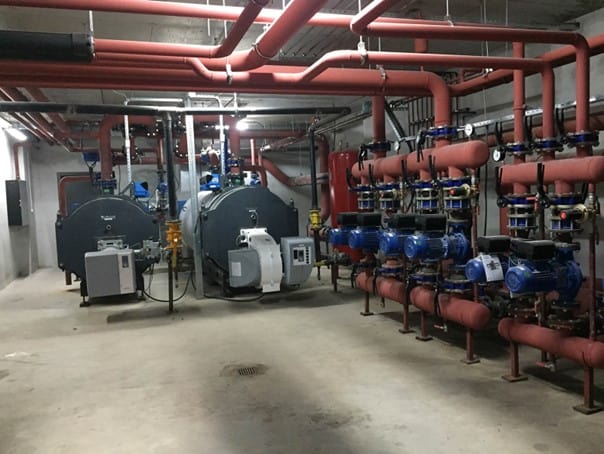
• Cleaning chemical (CEWA-200) is added to systems filled with water—such as boilers, chillers, heat exchangers, and similar equipment—that are equipped with bypass connections and have drain and fill points at appropriate locations.
• Under operating conditions, the system is circulated for at least 48 hours. Drainage is performed simultaneously from all outlet points.
• Next, the plumbing system is filled with tap water, and circulation is maintained for 24 hours to flush the system.
• After 24 hours, the rinse water is drained from the lower outlets, and all strainers in the circulation system are cleaned.
• The piping is refilled with water, water is supplied to the entire system, and the fill-and-drain procedure is performed. *Fill-and-Drain Procedure: While the system is circulating under operating conditions (appropriate pressure, number of pumps, etc.), drainage is performed from the point farthest from the fill point; this process continues until the drained water approaches the values of the incoming water.
• Feed-and-discharge operations are performed until the chemical parameters of the discharge water approach those of the influent water.
• Based on the results of chemical and biological measurements taken in the piping systems following the fill-and-drain procedures, a protective chemical (CK-42) and a biocide (C-BIOCIDE 900) are added, and the system is incorporated into the piping protection program.
Some of the water treatment products we have developed at Cemkimsan Kimya and manufacture at our plants include:
CEWA 200; Neutral cleaner for dirt, grease, and rust
CK 42; A protective chemical used in closed-loop heating and cooling systems.
CK 13; A protective chemical used in closed-loop heating and cooling systems.
C BIOCIDE 900; A biocide designed for microorganism control in closed-loop systems.
Resul AĞBULUT
Chemical Engineer
Water Treatment Consultant
Source:
TMMOB Chamber of Chemical Engineers Water Handbook
Cemkimsan Chemistry Lecture Notes
https://www.ktto.net/wp-content/uploads/2014/12/tekniksartname01.pdf