
Corrosion:
The corrosion process is a complex electrochemical reaction.
The operational load and stress on the system, pH conditions, and the chemical composition of the environment have a significant impact on corrosion formation.
Mechanical plumbing pipes and fittings made of steel, aluminum, copper, and their alloys are subject to corrosion in any environment containing oxygen and water.
Crack Corrosion:
It is difficult for the surrounding electrolyte to penetrate a fine crack, a narrow gap, a pocket, or the space between two plates on a metal surface. These narrow areas create a stagnant zone. The corrosion rate in these zones is higher than on normal surfaces. This is known as crevice corrosion.
Similarly, under-the-shell corrosion (filiform corrosion) and deposit corrosion, which occur through the same mechanism, can also be addressed within this group.
The basic mechanism of stress corrosion cracking is as follows.
Since the flow of electrolyte within the crack is very slow, the oxygen concentration in this region is lower than that of the surrounding area. This difference leads to the formation of a concentration cell between the interior of the crack and the surrounding area. The interior of the crack acts as the anode, and the surrounding area acts as the cathode. The anode and cathode reactions here are as follows:
Fe = Fe²⁺ + 2 e⁻
½ O₂ + H₂O + 2e⁻ = 2 OH⁻
Initially, these reactions occur at the same rate both inside and outside the crack.
As iron becomes an ion, it donates its electrons to oxygen and forms an OH- ion.
Thus, for every metal ion that dissolves into the solution, two hydroxide ions are formed.
After these reactions have proceeded for a while, the oxygen inside the crack begins to run out.
Since the interior of the crack is a stagnant environment, it is not possible for fresh oxygen to replace the oxygen that has been consumed. However, since fresh oxygen will replace the oxygen consumed on the surfaces outside the crack, there will be no change in the corrosion rate in these areas.
Although anode and cathode regions initially form both inside the crack and on its surface, once the oxygen inside the crack is depleted, the oxygen reaction proceeds on the outer surfaces, while metal dissolution occurs inside the crack.
As a result, the concentration of Fe++ ions within the crack increases.
This situation causes CI- ions to migrate into the crack due to polar effects.
FeCl₂ forms inside the crack.
This compound readily hydrolyzes in water and precipitates as iron hydroxide according to the following reaction.
FeCl₂ + 2 H₂O = Fe(OH)₂ + 2 H⁺ + 2 Cl⁻
Precautions:
The following measures can be taken to prevent crevice corrosion:
1. Welding should be preferred over bolts and rivets.
2. The joints where the two sheets meet must be sealed by welding or soldering.
3. When designing containers for holding liquids, care must be taken to ensure that the container can be completely emptied. There should be no corners inside the container that cannot be cleaned or washed.
4. You should check from time to time to see if there is any sediment or buildup in the container.
5. Materials such as wood and plastic that can remain wet should not come into contact with metal.
Cemkimsan Kimya bünyesinde geliştirdiğimiz ve fabrikalarımızda ürettiğimiz bazı su şartlandırma ürünlerimiz;
CEFOPOL 1080; Multifunctional boiler water treatment chemical.
CEFOPOL 1040; An NSF-certified scale and corrosion inhibitor suitable for use in food production steam boilers.
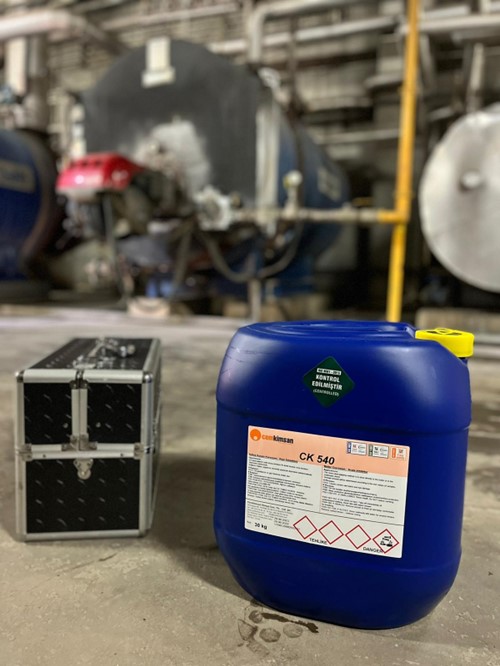
CK-540; A multifunctional boiler treatment chemical for steam boilers.
CEFOPOL 6030; Hardness stabilizer and scale inhibitor for steam boilers.
CEFOPOL 6018; A fully polymer-based boiler water treatment chemical.
CEFOLIN 1080; A multifunctional boiler and steam line treatment chemical.
CEMOLIN 1080; An NSF-certified steam line corrosion inhibitor suitable for use in food production.
Source:
Cemkimsan Ders Notları
https://www.kmo.org.tr/resimler/ekler/f51288c412df764_ek.pdf
http://dspace.yildiz.edu.tr/xmlui/bitstream/handle/1/10398/0042247.pdf?sequence=1&isAllowed=y