
What Is Drift and What Causes It?
Carryover is the transport of boiler water along with steam in boilers that generate steam. It is generally caused by mechanical and chemical factors.
Mechanical causes;
· Improper boiler concentration
· Improper boiler water level
· Sudden load changes and peak steam draw
· Overworking the boiler.
In addition to these, the chemical cause is that an increase in the concentration of solids in the boilers leads to foam formation, which in turn causes entrainment.
How Does Foam Form in a Steam Boiler?
Steam transitions from the liquid phase to the vapor phase at the surface of the steam boiler. Water molecules transitioning from the liquid phase to the vapor phase encounter suspended solids in the surface layer—which are present due to high conductivity (high impurity levels)—that surround the vapor bubbles; these solids subsequently form a rigid structure, making it difficult for water molecules to transition from the liquid phase to the vapor phase. By forming a rigid structure, they cause bubble formation. These bubbles resist breaking apart and lead to foam formation. The smaller the suspended solids are, the greater their potential to accumulate on the bubbles.
In addition, when oil, organic matter, silica, salts, total dissolved solids, and the total alkalinity of the boiler water interact with the high pressure and temperature inside the boiler, they cause foaming.
The foam that forms carries the boiler water into the steam line, causing entrainment.
What Are the Dangers of Drifting?
Due to the reasons mentioned above, the boiler water, carrying impurities along with the steam, causes deposits to form in the steam/condensate line and at steam usage points (heat exchangers, coils, etc.), leading to scale and corrosion…
The steam quality decreases, and the products it comes into contact with are damaged.
This results in improper postures, as well as a loss of labor, time, and energy.
Another important point to keep in mind is that you should not prevent the boiler water from foaming, as the foam can cause the boiler to run dry and burn out.
How Can Drifting Be Prevented?
The most common method for controlling the concentrations of substances that cause foaming—such as silica, total dissolved solids, total alkalinity, oil, and organic matter in boiler water, which are the primary causes of scum formation in boilers—is thehttps://cemkimsan.com.tr/buhar-kazanlarinda-blof/ process.
Although various organizations provide different limit values for these parameters, the most accurate approach is for each business to determine its own operating limits based on its specific operating conditions and experience.
To prevent foam formation, the boiler water concentration must be maintained at an appropriate level, and special attention must be paid to surface blowdown.
In cases where foam formation cannot be prevented, defoamers can be used.
Appropriate steam separation devices, such as steam traps and separators, should be installed and inspected regularly.
Steam traps are one of the most important components of steam systems. They are devices that automatically discharge air, gas, and condensate (water) while retaining steam. They are used downstream of steam-using equipment or at drain points along steam lines.
Separators are used at the boiler outlet and before the equipment; (water separators) they separate water droplets and condensate film from the steam, allowing dry steam to pass through.
The water level in the boiler must be kept within the appropriate range.
Sudden vapor draw and overloads in the system should be avoided.
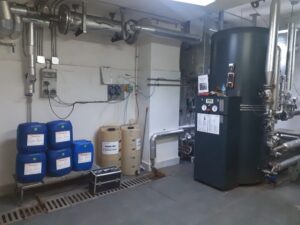
The steam boiler protection products we have developed in-house at Cemkimsan Kimya and manufacture at our factory our steam boiler protection products;
· Cefopol 1080 (Multifunctional boiler water treatment chemical)
· Cefopol 1040 (NSF-certified scale and corrosion inhibitor for steam boilers, suitable for use in food production)
· Cemolin 1080 (NSF-certified steam line corrosion inhibitor suitable for use in food production)
Source:
Cemkimsan Chemistry Lecture Notes
TMMOB Chamber of Chemical Engineers Water Handbook
https://www.suvecevre.com/yayin/553/buhar-kazani-blof-uygulamasi_16368.html#.YiKHC-hBzIV
https://www.termodinamik.info/buhar-tesisatlarindan-kondens-tahliyesi-ve-kondenstoplar
https://dargeb.com/kazan-sistemleri-sartlandirma-4/
https://www.cemkimsan.com.tr/post/buhar-kazanlarinda-bl%C3%B6f