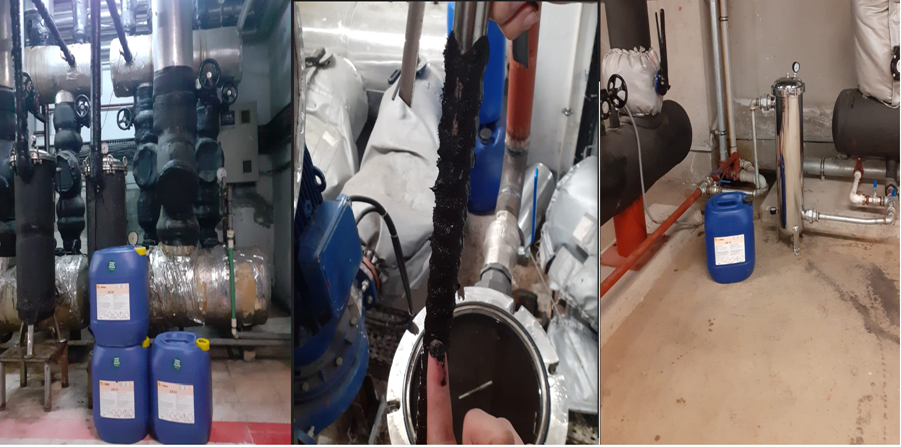
The Use of Bag Filters in Closed-Loop Systems
Closed-loop systems are systems in which the same water circulates, there is no water loss due to evaporation, and no blowdown is required. The fluid (usually water) within a closed-loop system contains fine, abrasive particles. These particles cause system downtime and increase maintenance costs. There are various causes for these particles. They are generally iron oxide deposits resulting from corrosion. Additionally, buildup and welding slag resulting from installation are examples of such deposits.
Suspended iron oxide particles and other deposits can form scale on pumps, valves, coils, and other components. The layers that accumulate on pipe surfaces also cause under-deposit corrosion in the system. In particular, boiler sludge forms in heating boilers as the system operates. These deposits must also be removed from the system.
In closed-loop protection systems, the system must first be chemically cleaned and protected. While chemical conditioning is the first step—particularly to prevent the formation of iron oxide—the best way to prevent suspended particles from damaging the system is to use a bypass bag filter.
This type of filtration system processes 5%–10% of the system volume. Clogging or contamination of the filter has no effect on the system’s operation. Cleaning the bag filter over time ensures that contaminants and sludge within the system are removed. The bag filter system does not cause water loss from the system during the cleaning phase. Consequently, there is no loss of chemicals in closed-loop systems where chemical protection is applied. Furthermore, since there is no water loss, the introduction of oxygen into the system via water replenishment is also prevented.
Bag filters are available with various pore sizes. In closed-loop systems, the pore size can be adjusted from 100 microns down to 1 micron. A pore size of 25 microns is ideal for closed-loop systems.
The bag filter consists of a 304 stainless steel housing. The filter bag is made of polyethylene. The bag filter capacity is custom-manufactured according to the system.
It is recommended to clean it once a month or once every 15 days. Depending on how dirty it is, it can be cleaned more frequently.
Thanks to the magnetic rotor it contains, it ensures that metal particles that are not captured by the filter are held in place by their magnetic properties.
Advantages of bag filters in closed-loop systems
– Keeps the system clean
– Protects the pump and equipment
– Prevents sudden system shutdowns
– Prevents maintenance and energy costs from rising.
How a bag filter works
When the circulation pump in the system starts operating, a pressure difference occurs between the inlet and outlet of the pump.
The bag filter uses this pressure difference to perform the filtration process within the system.
Water flows from the circulation pump into the bag filter, and the outlet of the bag filter is connected to the inlet of the circulation pump. This creates a small water loop within the circulation pump, and the filtration process is carried out by the filter bag and magnetic rod inside the bag filter.